
When a worker gets hurt on the job, the goal is simple: get them back on their feet as quickly and safely as possible. But behind every treatment plan is a hidden cost battle-one that’s reshaping how medications are prescribed in workers’ compensation cases. Generic substitution isn’t just a pharmacy policy. It’s a legal and clinical standard that’s now standard practice in 44 U.S. states and the District of Columbia. And by 2025, nearly 94% of all prescription drugs used in workers’ comp cases are expected to be generics.
Why Generic Drugs Are the New Standard
Generic drugs aren’t cheap knockoffs. They’re FDA-approved copies of brand-name medications with the same active ingredients, strength, dosage form, and how they work in your body. The difference? Price. A brand-name painkiller like Voltaren Gel might cost $120 for a tube. The generic version? Around $20. That’s not a guess-it’s data from myMatrixx, which tracks pharmacy trends across workers’ comp systems nationwide. In 2015, only 84.5% of prescriptions in workers’ comp cases were generics. By 2023, that number jumped to 89.2%. California’s formal drug formulary pushed utilization to 92.7% by 2022. Colorado’s 2023 rule now requires 95% generic use for covered drugs, effective January 2024. These aren’t random changes. They’re responses to a broken pricing system. Brand-name drug prices rose 159% over ten years, according to JAMA. Meanwhile, the cost of milk and bread went up just 7.4%. Generic drug prices? They dropped 35% in the same period. For employers and insurers, that’s not just savings-it’s survival. Workers’ comp pharmacy costs make up about 20% of total medical spending in these cases. When drug prices spiral, the whole system feels it.How It Works: The Legal and Clinical Rules
It’s not up to the doctor or the worker to decide whether to use a generic. In most states, the law does. Tennessee’s 2023 Workers’ Compensation Medical Fee Schedule says it plainly: “An injured employee should receive only generic drugs… unless the authorized treating physician documents medical necessity for the brand-name product.” That means if a doctor wants to prescribe the brand name, they can’t just say, “I prefer it.” They need clinical proof-something like a documented allergy, a failed trial of the generic, or a specific condition that makes the brand the only safe option. Pharmacy Benefit Managers (PBMs)-companies like OptumRx, Express Scripts, and Prime Therapeutics-run the formularies that control what gets covered. They flag brand-name drugs for prior authorization. If the prescriber doesn’t respond with proper documentation, the pharmacy won’t fill it. This isn’t bureaucracy. It’s a system designed to stop unnecessary spending. The FDA’s Orange Book lists every approved generic and its therapeutic equivalence rating. Only drugs rated “AB” are considered fully interchangeable. If a drug isn’t rated AB, it can’t be substituted without a doctor’s approval. This keeps patients safe from risky switches, especially with narrow therapeutic index drugs like warfarin or thyroid meds, where tiny differences matter.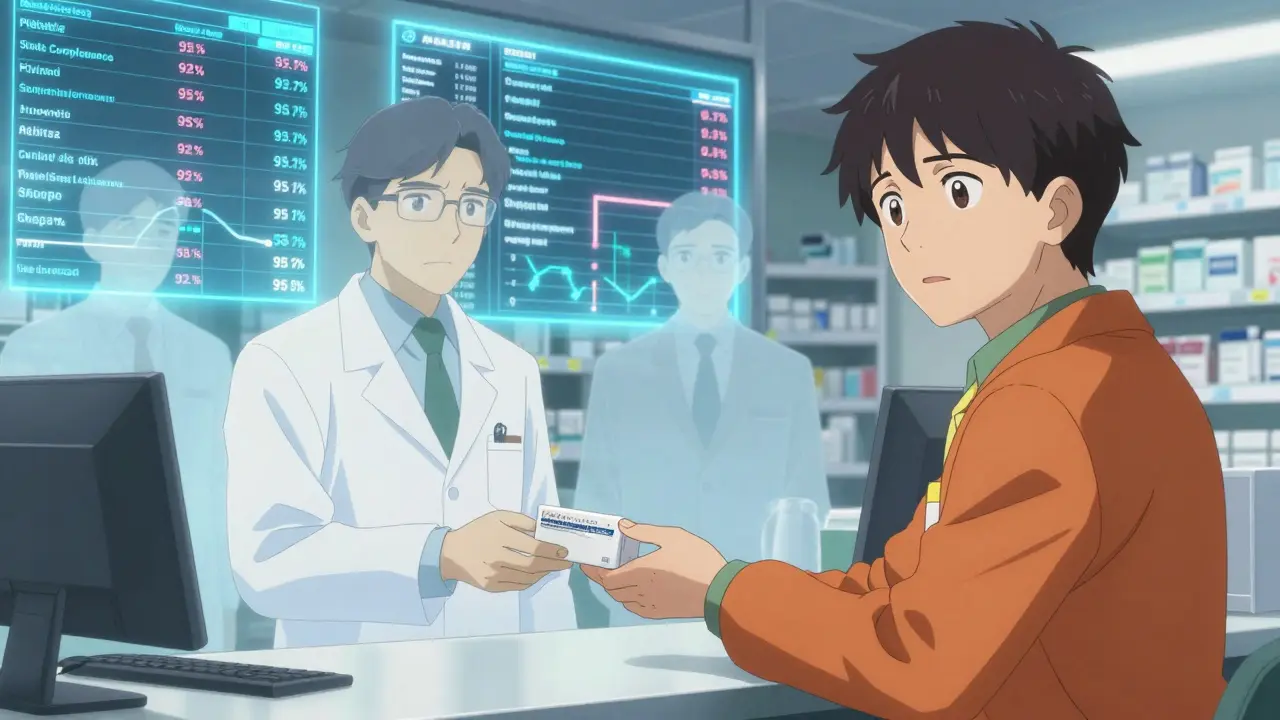
Why Some Workers and Doctors Still Resist
Even with all the data, resistance lingers. A 2019 survey by Reduce Your Workers’ Comp Blog found that 68% of injured workers believed brand-name drugs were better. That belief didn’t vanish after they took the generic-82% said they felt the same relief, but many still thought the brand was “stronger.” Doctors, too, sometimes default to brands. Why? Habit. Lack of training. Or fear of a patient complaint. One nurse practitioner in Ohio told a 2022 NursingCenter.com interview: “I’ve had workers cry because they thought I was giving them ‘junk medicine.’ I had to show them the FDA’s bioequivalence standards on my phone.” It’s not just perception. There are real, though rare, cases where generics don’t work the same. Less than 2% of all substitutions result in therapeutic failure, according to Coventry’s 2016 report. But when it happens, it’s loud. A worker might say, “The generic didn’t help,” and the doctor, unsure of the cause, may revert to the brand. That’s why clear documentation and patient education are critical.The Hidden Problems in the Generic Market
Here’s the twist: not all generics are cheap anymore. The market used to be a race to the bottom. Dozens of manufacturers competed, driving prices down. But over the last five years, consolidation has changed the game. A few big players now control most of the supply. Enlyte’s 2022 analysis found evidence of anti-competitive behavior-price-fixing, supply shortages, and collusion-that’s pushing generic prices up in some cases. Take the muscle relaxant cyclobenzaprine. In 2018, it cost $5 for a 30-day supply. By 2023, it jumped to $42. Why? Only two manufacturers were making it. One shut down production. The other raised prices. No competition. No drop. Even more concerning: specialty drugs. These are complex, high-cost medications-like biologics for nerve pain or autoimmune conditions-that make up 12.7% of workers’ comp pharmacy spending. But only 4.3% of them have generic equivalents. That’s where the next cost crisis is brewing. The first workers’ comp biosimilar (a type of advanced generic for biologic drugs) was approved in Texas in 2022. But scaling these across states will take years.
Brian Furnell
December 22, 2025 AT 01:59Let’s be real-generic substitution isn’t just about cost-cutting; it’s a pharmacoeconomic paradigm shift. The FDA’s AB-rating system is the linchpin here, ensuring bioequivalence at scale. But when PBMs like OptumRx enforce formularies without clinical nuance, you get therapeutic inertia. We’re seeing 94% generic penetration by 2025, sure-but what about the 2% failure rate? That’s not noise; it’s a systemic blind spot. We need pharmacogenomic integration, stat. Otherwise, we’re just automating harm under the banner of efficiency.
Siobhan K.
December 22, 2025 AT 19:44So let me get this straight-workers are being forced to take $20 pills because the brand costs $120, but when the generic doesn’t work, they’re told it’s ‘their fault’ for not ‘adapting’? The irony is thick enough to spread on toast. Meanwhile, the same companies that profit off brand-name drugs own the PBMs that enforce these rules. It’s not healthcare. It’s corporate theater with a side of placebo.
Teya Derksen Friesen
December 24, 2025 AT 10:14While the data presented is statistically robust and aligns with national trends in cost containment, it is imperative to acknowledge the human dimension of pharmaceutical substitution. The psychological impact on injured workers-particularly those with chronic pain-cannot be quantified through formulary utilization metrics alone. Empathy must be institutionalized alongside policy.
Cara C
December 24, 2025 AT 10:47It’s not about brand vs generic. It’s about trust. If a worker’s been on a brand for months and the switch makes them feel worse, they’re not being difficult-they’re being honest. Doctors need more time to explain, not more forms to fill out. Maybe if we stopped treating patients like line items, this system wouldn’t feel so broken.
Erika Putri Aldana
December 25, 2025 AT 23:24generic drugs are just cheap junk. the FDA is corrupt. i got my back meds from walmart and i could barely walk. they’re letting china make our pills. this is why america is dying. 💀
Grace Rehman
December 27, 2025 AT 21:28They call it substitution but it’s really rationing dressed up as science. We’ve turned medicine into a spreadsheet and wonder why people feel like commodities. The real question isn’t whether generics work-it’s why we’ve accepted a system that makes healing feel like a privilege
Adrian Thompson
December 28, 2025 AT 12:3544 states enforcing generics? That’s socialist pharmacy. The government’s telling doctors what to prescribe now. Next they’ll ban caffeine and mandate kale smoothies for workers. This is how they control the masses. Brand names are American. Generics are made in Beijing. Wake up.
Jackie Be
December 30, 2025 AT 05:11OMG I just got my generic naproxen and my pain went from 5 to 10?? I thought I was getting the same thing?? This is a scam!! I’m suing someone!!
John Hay
December 30, 2025 AT 10:55My cousin’s a claims adjuster and he says the real issue isn’t generics-it’s the PBM kickbacks. Companies get paid to push certain brands even when generics are available. So it’s not about savings-it’s about who’s getting the cut. Fix the middlemen first.
Jon Paramore
December 30, 2025 AT 14:14Therapeutic equivalence AB rating = FDA gold standard. Non-AB = no substitution. Cyclobenzaprine price spike? Monopoly. 2 manufacturers → 1 shutdown → 1 hikes. Classic Oligopoly. PBMs need transparency mandates. Pharmacovigilance must be proactive, not reactive.
Peggy Adams
December 30, 2025 AT 20:28so like... the whole thing is just a big scam? everyone’s lying? the doctors? the pharmacists? the government? i’m just trying to get better and now i have to be a detective just to get my medicine??
Sarah Williams
January 1, 2026 AT 15:10Just because it’s cheaper doesn’t mean it’s worse. I’ve been on generics for years and I’m still here. Talk to your pharmacist. Ask for the FDA info. You’re not alone in this. We’ve got this.