
More than half of people taking medication for mental health conditions don’t take them as prescribed. It’s not laziness. It’s not rebellion. It’s not lack of care. It’s a complex mix of biology, life circumstances, and system failures. For someone with schizophrenia, bipolar disorder, or severe depression, skipping pills can mean hospitalization, relapse, or worse. And yet, the system keeps treating non-adherence like a personal failing instead of a public health crisis.
Why People Stop Taking Their Mental Health Medication
It’s easy to assume people forget. But forgetting isn’t the main issue. A 2024 study in the Journal of Psychiatric Research found that insight-or lack of it-is the biggest driver. If someone doesn’t believe they’re sick, they won’t believe they need the medicine. This isn’t denial. It’s a symptom. Schizophrenia, bipolar disorder, and even severe depression can damage a person’s ability to recognize their own illness. That’s not a choice. It’s neurobiology.
Then there’s side effects. Weight gain. Drowsiness. Emotional numbness. Sexual dysfunction. These aren’t rare. They’re common. And when you’re already struggling to get out of bed, adding a pill that makes you feel like a zombie isn’t appealing. A 2025 survey from the National Alliance on Mental Illness (NAMI) found that 68% of patients stopped their medication because of side effects, not because they felt better.
Cost matters too. A 30-day supply of antipsychotics can cost $300 out-of-pocket. For someone on disability, that’s rent money. Insurance often doesn’t cover long-acting injectables-medications that work for weeks or months with one shot-because they’re seen as "premium." But they’re the most effective. A 2023 JAMA Psychiatry study showed 87% adherence with injectables versus 56% with pills. Yet only 12% of patients have access to them.
And then there’s the daily grind. Taking pills three times a day sounds simple until you’re homeless, unemployed, or living in a chaotic environment. A 2022 analysis from San Diego found homeless psychiatric patients had adherence rates as low as 26%. No fridge? No stable address? No one to remind you? It’s not about willpower. It’s about survival.
What Actually Works: The Evidence
There’s a myth that apps and reminders fix non-adherence. They don’t. A 2025 review of digital tools found they improved adherence by just 1.8%. That’s noise, not progress. Real change comes from human connection-specifically, from pharmacists working directly with psychiatrists and patients.
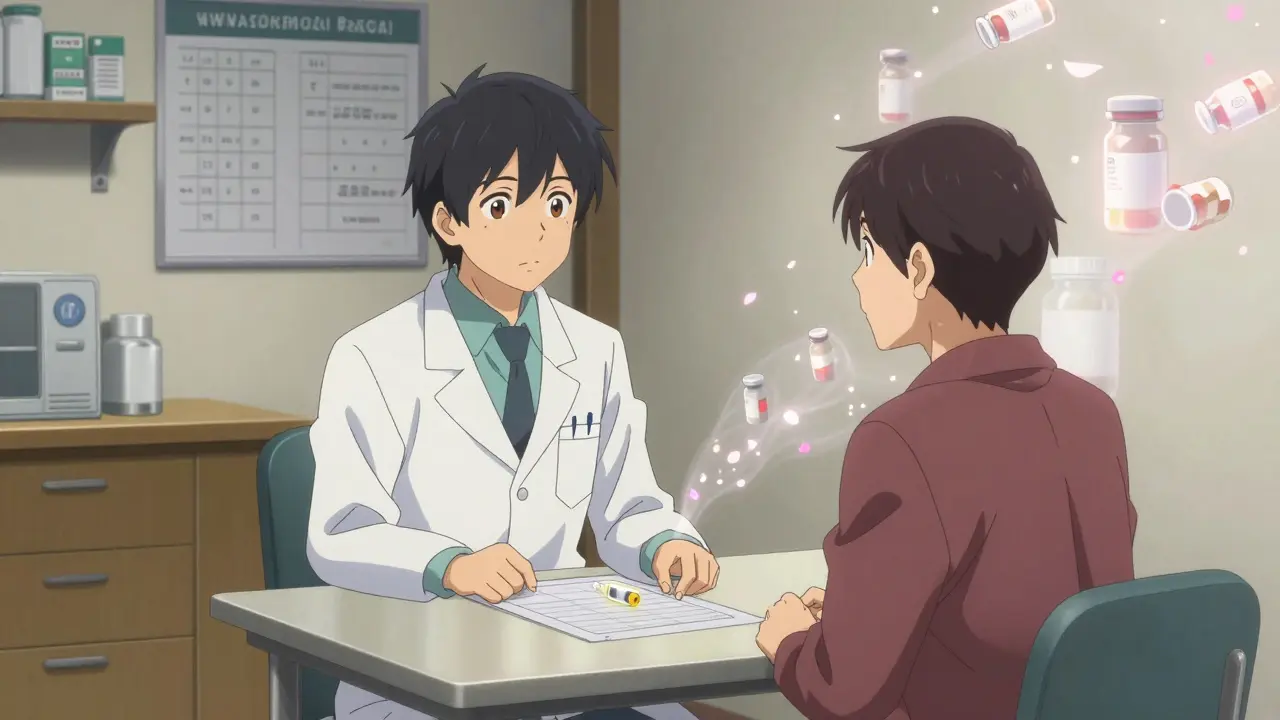
Pharmacist-led care isn’t a buzzword. It’s a lifeline. In Kaiser Permanente’s Northern California system, a pharmacist-led program called Medication Regimen Management (MRM) boosted adherence by 32.7% in just 90 days. How? They didn’t just hand out pills. They sat down with patients. Asked about side effects. Adjusted dosing. Found out if they could afford the meds. Connected them to free drug programs. Reduced three-times-daily regimens to once-daily where safe. And guess what? Hospitalizations dropped by 18.3%.
A 2025 randomized trial in Frontiers in Psychiatry compared standard care with collaborative care-pharmacist, psychiatrist, and patient meeting weekly. The collaborative group improved adherence by 142% more than the control group. Why? Because they treated adherence as a team sport. The pharmacist knew the meds. The psychiatrist knew the illness. The patient knew their life. Together, they built a plan that fit.
One of the most overlooked tools? Simplifying the regimen. If you’re on five pills a day, you’re more likely to miss one. If you’re on one pill once a day? Adherence jumps. NAMI’s survey showed 87% adherence with once-daily dosing versus 52% with multiple doses. Yet 73% of patients said their doctor never even asked if they could simplify it.
The Hidden Barrier: Cost and Access
It’s not enough to know what works. You have to be able to get it. In 2025, 64% of patients on Reddit’s r/mentalhealth community said they couldn’t access pharmacist-led care because insurance wouldn’t cover it. That’s not a glitch. It’s policy. Medicare and private insurers still treat medication management as a "pharmacy service," not a medical one. They pay for doctor visits. They pay for therapy. But they don’t pay for a pharmacist to sit with you for 30 minutes and reorganize your meds.
Meanwhile, the CDC’s Healthy People 2030 initiative has made improving mental health adherence a national priority. But priorities don’t pay bills. CMS now ties 7 of its 13 Medicare Advantage quality measures to adherence. If a plan’s patients aren’t taking meds, the plan loses money. But the plan doesn’t pay for the solution. It just punishes the provider. It’s a broken incentive.
Long-acting injectables are the gold standard. But they’re expensive. And they require clinic visits. For someone without transportation, a job, or stable housing, that’s a mountain. Yet they’re 31% more effective than pills. If we want adherence to rise, we need to fund mobile clinics, mail-order injectables, and transport vouchers-not just more apps.
What’s Changing in 2026
There’s momentum. In 2025, CMS rolled out MIPS Measure #383, which requires all providers treating schizophrenia or schizoaffective disorder to track Proportion of Days Covered (PDC). If a patient’s PDC is below 80%, it counts against the provider. That’s a big deal. For the first time, non-adherence is being measured like blood pressure or HbA1c.
The FDA also updated its guidance in 2024, explicitly endorsing long-acting injectables as tools to improve adherence. And Epic Systems-the largest EHR vendor-is building real-time adherence analytics into its 2026 release. Clinicians will soon see alerts: "Patient missed 3 doses in 14 days. Consider switching to injectable." That’s not surveillance. It’s early intervention.
But here’s the catch: technology doesn’t fix poverty. AI can predict who’ll miss a dose. But it can’t pay their rent. No algorithm can hand someone a bus pass so they can get to their monthly injection. That’s why the most successful programs combine tech with human support: pharmacists who know local resources, case managers who can connect patients to housing, and peer navigators who’ve been there.
What You Can Do-If You’re a Patient
If you’re struggling to take your meds, you’re not alone. And you’re not broken. Here’s what to try:
- Ask about once-daily options. Many antipsychotics and antidepressants now come in once-a-day forms. Ask your doctor if you can switch.
- Request a medication review. Go to your pharmacy and ask the pharmacist to go over your entire list. They can spot interactions, simplify regimens, and help you find cost-saving programs.
- Ask for long-acting injectables. If you’re on antipsychotics, ask if you’re a candidate. You might need to go to a clinic once a month-but you won’t need to think about pills every day.
- Find a medication specialist. Some clinics have pharmacists who specialize in mental health. They’re not just dispensers. They’re collaborators.

What You Can Do-If You’re a Provider
- Stop blaming patients. Non-adherence isn’t a failure of compliance. It’s a failure of design.
- Partner with a pharmacist. You don’t need to become an expert in drug costs or dosing schedules. Let the pharmacist handle it. Collaborative care increases adherence by 35%.
- Offer simplification as standard. Don’t wait for the patient to ask. Ask them: "Can we make this easier?"
- Advocate for coverage. Push your clinic or health plan to cover long-acting injectables and pharmacist visits. They save money in the long run.
Final Thought: This Isn’t About Pills
Medication non-adherence in mental health isn’t a patient problem. It’s a system problem. We’ve built a system that expects people to manage complex medical regimens while they’re ill, poor, isolated, and often traumatized. And then we blame them when they can’t.
Real progress means treating adherence like diabetes care: with teams, with support, with access, and with compassion. It means pharmacists as part of the care team-not just the people who hand out bottles. It means injectables as standard, not luxury. It means asking, "What’s stopping you?" instead of "Why didn’t you take it?"
The tools exist. The evidence is clear. What’s missing is the will to change.
Why do people with mental illness stop taking their medication?
People stop taking mental health medication for many reasons, not because they don’t care. Common causes include lack of insight into their illness, troubling side effects like weight gain or drowsiness, inability to afford the medication, complex dosing schedules, and unstable living situations like homelessness or unemployment. For many, the medication feels worse than the symptoms.
Is non-adherence really a big problem?
Yes. Globally, 40% to 60% of people with mental health conditions don’t take their medication as prescribed. In the U.S., non-adherence contributes to up to 25% of all hospitalizations and is linked to 125,000 preventable deaths each year. For schizophrenia, adherence is only about 50%, far below the 80% needed for stable outcomes. It’s a silent crisis with massive human and financial costs.
Do medication reminder apps help?
Not really. Studies show apps improve adherence by only about 1.8%. That’s statistically significant but clinically meaningless. Non-adherence isn’t about forgetting-it’s about side effects, cost, distrust, or lack of insight. A phone alert won’t fix a $300 pill bill or emotional numbness. Human support does.
What’s the most effective intervention?
The most effective approach is pharmacist-led collaborative care. When pharmacists work directly with psychiatrists and patients, adherence improves by up to 40%. They simplify regimens, reduce costs, manage side effects, and connect patients to resources. A 2025 study found this model led to 142% greater improvement than standard care. It’s not magic-it’s teamwork.
Are long-acting injectables better than pills?
For many, yes. A 2023 study in JAMA Psychiatry found that long-acting injectable antipsychotics had 87% adherence compared to 56% for oral pills. They eliminate daily dosing, reduce relapse risk, and improve stability. Yet they’re often not covered by insurance, even though they save money by preventing hospitalizations. They should be a first-line option-not a last resort.
Can simplifying my medication regimen help?
Absolutely. A NAMI survey found that 87% of patients stayed adherent when on a once-daily regimen, compared to only 52% on multiple daily doses. If you’re taking three pills a day, ask your doctor if you can switch to a once-daily option. Many modern medications allow this. It’s one of the easiest, cheapest fixes.
Kevin Y.
March 25, 2026 AT 17:20Thank you for laying this out so clearly. I’ve seen too many patients fall through the cracks because we treat adherence like a personal failing instead of a systems problem. Pharmacists aren’t just dispensers-they’re frontline care coordinators. In my clinic, we started pairing every psychiatrist with a clinical pharmacist, and hospital readmissions dropped by nearly 20% in six months. It’s not rocket science. It’s basic teamwork.
Let’s stop pretending willpower is the solution. People aren’t lazy. The system is broken.
Raphael Schwartz
March 26, 2026 AT 05:44Aaron Sims
March 27, 2026 AT 22:35Caroline Bonner
March 29, 2026 AT 06:20Oh my gosh, this article literally made me cry-I’ve been through this, and I’m not even the patient, I’m the sibling. My brother has schizoaffective disorder, and for years, we were stuck in this awful loop: he’d stop meds because of the weight gain, then spiral, then get hospitalized, then get put back on the same meds, and repeat. It wasn’t until his pharmacist sat down with him-no judgment, just questions like, "What’s the one thing that makes taking pills feel impossible?"-that things changed.
They switched him to a once-daily injectable, connected him with a food bank for healthy meals (because the meds made him crave junk food), and even helped him get a free bus pass. He’s been stable for 14 months now. It’s not magic. It’s just… human contact. Why is that so hard to fund?
Also, I’m so tired of people saying "just take your meds." If you’ve never felt like a zombie while your depression screams at you to disappear, you have no idea what you’re asking someone to do.
Seth Eugenne
March 30, 2026 AT 22:13Alex Arcilla
March 31, 2026 AT 05:22Stephen Alabi
April 1, 2026 AT 02:57Agbogla Bischof
April 2, 2026 AT 22:09As a psychiatrist from Nigeria, I can confirm this is universal. In Lagos, we have patients who walk 12 kilometers to get their monthly injection because they have no transport. No fridge? No problem-we use cold packs. No pharmacy? We send a nurse. The problem isn’t the illness-it’s the infrastructure. We don’t need more apps. We need more trained community health workers. And we need to pay them. In the U.S., pharmacists are overworked. In Nigeria, they’re underpaid and undertrained. The solution is the same: invest in people, not pills.
Also, long-acting injectables are cheaper per dose. Why are insurers resistant? Because they don’t understand long-term savings. They think in quarterly reports. We need to change the accounting, not the patient.
Pat Fur
April 3, 2026 AT 06:21peter vencken
April 3, 2026 AT 18:48Chris Crosson
April 4, 2026 AT 23:46Linda Foster
April 6, 2026 AT 13:31Rama Rish
April 8, 2026 AT 08:27