
Every year, millions of people take prescription drugs, over-the-counter medicines, and supplements without a second thought. But what happens when something goes wrong? A strange rash. A sudden drop in blood pressure. A baby born with a birth defect after the mother took a common prenatal vitamin. These aren’t rare outliers-they’re signals. And MedWatch is the system designed to catch them.
MedWatch isn’t a website you visit when you’re sick. It’s not a hotline you call in panic. It’s the U.S. Food and Drug Administration’s official channel for reporting problems with medications, medical devices, vaccines, and even cosmetics. If you’ve ever wondered whether your side effect was "normal" or worth reporting, the answer is: yes, report it. Because you’re not just protecting yourself-you’re helping protect others.
What Exactly Is MedWatch?
MedWatch, officially called the FDA Safety Information and Adverse Event Reporting Program, started in 1993. It was created because drug safety doesn’t end when a medication hits the market. Clinical trials test drugs on thousands of people. But real life? Millions of people take the same drug, with different health conditions, other medications, and genetic differences. That’s where hidden dangers show up.
Think of MedWatch as a national early-warning system. It collects reports from doctors, pharmacists, patients, and manufacturers. These reports help the FDA spot patterns: a new type of liver damage linked to a common painkiller, a heart rhythm problem tied to a diabetes drug, or a device that fails under normal use. Since its launch, MedWatch data has led to over 100 label changes, safety alerts, and even drug withdrawals.
The program covers everything the FDA regulates: prescription and OTC drugs, biologics like insulin and gene therapies, medical devices (from pacemakers to glucose monitors), dietary supplements, infant formula, and even cosmetics. If it’s sold in the U.S. and meant for human use, it’s in scope.
Who Can Report? And How?
You don’t need to be a doctor. You don’t need to prove anything. You don’t even need to be sure it was the medication. If you think a product caused a problem, report it. The FDA doesn’t investigate every single report-they look for patterns. One report might mean nothing. Ten reports of the same issue? That’s a red flag.
There are three main ways to report:
- Healthcare professionals use Form FDA 3500. This is the detailed version. It asks for patient age, medical history, lab results, and exact timing of the event.
- Patients and consumers use Form FDA 3500B. It’s shorter, simpler, and now available in Spanish. You only need the product name, what happened, and your contact info.
- Manufacturers are legally required to report serious events within 15 days. They use Form FDA 3500A or submit electronically.
You can report online at fda.gov/MedWatch, by phone at 1-800-FDA-1088, by fax, or even by mail. The online form takes 15 to 20 minutes. No cost. No registration. No follow-up required-but you can leave your email if you want confirmation.
What Counts as a Reportable Event?
Not every minor side effect needs reporting. The FDA defines serious events as those that:
- Result in death
- Require hospitalization
- Cause permanent disability
- Lead to a birth defect
- Are life-threatening
- Require medical or surgical intervention to prevent serious outcomes
Examples: A 68-year-old man develops severe internal bleeding after starting a new blood thinner. A teenager has a seizure after taking an OTC cold medicine with dextromethorphan. A woman gives birth to a baby with a cleft palate after taking a supplement marketed for "natural fertility support." These aren’t just bad luck-they’re data points.
Even if you’re not sure, report it. The FDA’s guidelines say: "When in doubt, report." They’d rather get 100 reports where nothing is wrong than miss one that could save a life.
Why Do So Few People Report?
Here’s the hard truth: only 1% to 10% of serious adverse events are reported to MedWatch. That’s not because people don’t experience them-it’s because they don’t know how, or they think it won’t matter.
A 2022 survey by the National Consumers League found 78% of Americans had never heard of MedWatch. Even among patients who had serious reactions, many assumed the doctor would report it. Or they thought, "It was just me. It won’t happen to anyone else."
But here’s what happens when reports pile up. In 2007, MedWatch received dozens of reports about chest pain and heart attacks in people taking rosiglitazone (Avandia). The FDA reviewed the data, added a black box warning, and later restricted its use. In 2019, reports of a rare brain condition linked to certain migraine drugs led to new safety labeling. In 2021, reports of severe allergic reactions to a new biologic drug prompted an emergency safety alert.
These weren’t lab studies. They weren’t clinical trials. They were real people, reporting real problems.
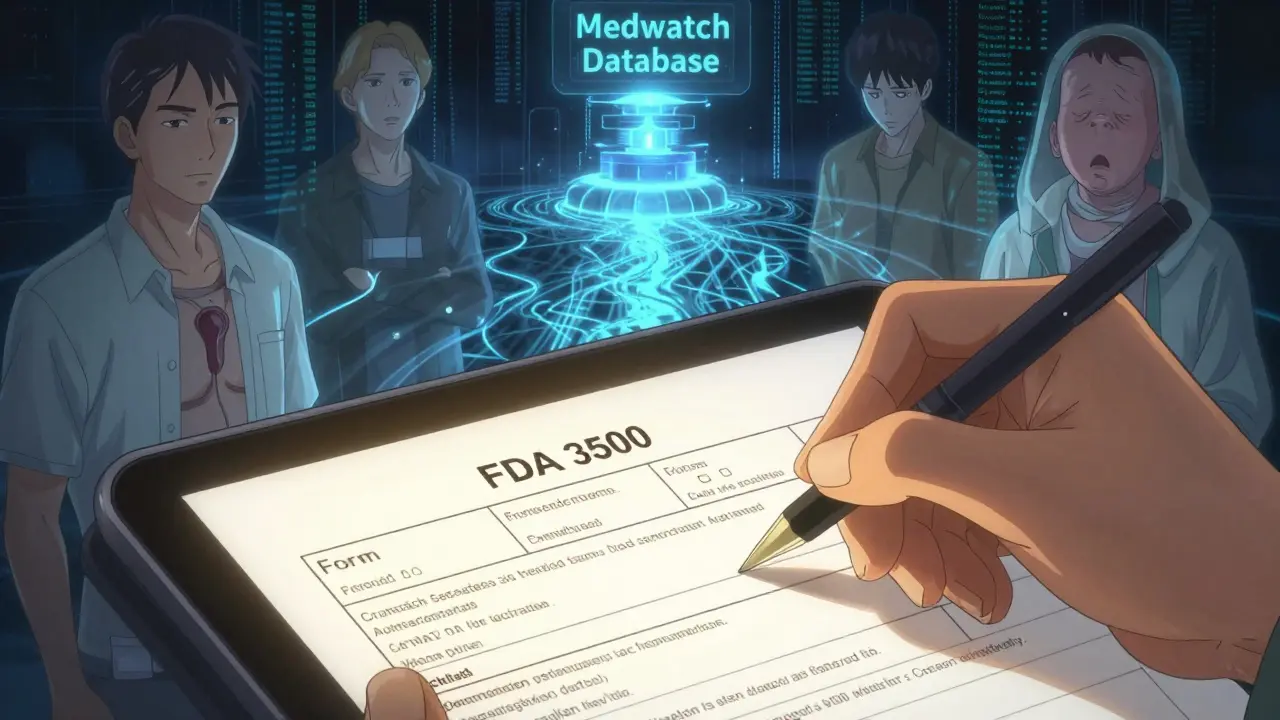
What Happens After You Report?
You won’t get a call. You won’t get a letter. The FDA doesn’t have the staff to respond to every report. But that doesn’t mean your report disappears.
Your report goes into a database with over 1.4 million entries per year. Trained analysts look for clusters: the same drug, same reaction, same symptom, reported by multiple people. If a pattern emerges, the FDA investigates further. They may:
- Update the drug label with new warnings
- Require the manufacturer to run a new safety study
- Issue a public safety alert
- Restrict how the drug is prescribed
- Remove the product from the market
In fiscal year 2021 alone, MedWatch data contributed to 18 label changes, 7 safety communications, and 3 product withdrawals.
Some reporters say they feel ignored. One doctor on Reddit said she reported a severe allergic reaction and had to send three follow-up emails to get confirmation. But the system works because of volume-not individual responses.
How MedWatch Compares to Other Countries
The U.S. isn’t alone. The European Union has EudraVigilance. Canada has the Canadian Adverse Reaction Monitoring Program. Japan only allows healthcare professionals to report. But MedWatch stands out because it accepts reports from anyone-patients included.
MedWatch gets about 1.2 million reports a year. EudraVigilance gets 750,000. But population size matters: the U.S. has about 331 million people. The EU has 447 million. So per capita, Americans report more. That’s partly because the system is easier to access.
Still, experts agree: passive reporting like MedWatch has limits. A 2021 study in JAMA Internal Medicine called it a "passive surveillance system" that misses common side effects. That’s why the FDA is now combining MedWatch with its Sentinel Initiative, which uses electronic health records from 300 million patients to actively scan for problems.
What’s Changing in MedWatch?
The system is getting smarter. In January 2023, the FDA launched an updated online portal with real-time validation checks. It now catches errors before you submit-like misspelled drug names or missing dates. Submission errors dropped by 27% in early testing.
They’re also testing AI to sort reports faster. A pilot program at the Center for Drug Evaluation and Research cut initial review time by 35% for high-priority cases.
By 2025, the FDA plans to let certified health apps and electronic health record systems send reports directly-no form needed. Imagine your doctor’s software automatically flagging a reaction and submitting it for you.
And starting in 2026, the FDA will require all reports to use standardized medical terms (SNOMED CT). That means "heart attack" and "myocardial infarction" will be treated as the same thing. That’s huge for data analysis.

What You Can Do Right Now
You don’t need to wait for a crisis. Here’s what to do:
- Know the product: Keep a list of all medications and supplements you take, including doses and start dates.
- Watch for new symptoms: If something unusual shows up after starting a new drug, write it down.
- Report it: Go to fda.gov/medwatch and use Form FDA 3500B. It takes less than 20 minutes.
- Share it: Tell friends, family, and your pharmacist. Most people still don’t know MedWatch exists.
You’re not just reporting a side effect. You’re adding a piece to a puzzle that helps save lives.
Common Myths About Reporting
- Myth: "My doctor will report it." Truth: Many doctors don’t. A 2022 study found only 42% of primary care providers report adverse events regularly. Oncologists and psychiatrists report more-but not everyone.
- Myth: "It’s not serious enough." Truth: If it was bad enough to worry you, it’s worth reporting. The FDA wants to know about all serious events, even if you’re unsure.
- Myth: "I’ll get in trouble." Truth: Reporting is anonymous. You don’t have to give your name. And you won’t be penalized for reporting a mistake.
- Myth: "It won’t make a difference." Truth: One report might not. But 50 reports? That’s how a drug gets pulled from the market.
Can I report a side effect if I’m not a U.S. citizen?
Yes. MedWatch accepts reports from anyone, anywhere in the world, as long as the product was sold or used in the United States. If you took a U.S.-approved drug while traveling, or if you bought it online from a U.S. pharmacy, you can report it. The FDA uses these reports to understand how products behave across different populations.
Do I need to prove the medication caused the problem?
No. MedWatch doesn’t require proof. It collects suspected reactions. The FDA’s job is to look at thousands of reports and find patterns. If 20 people report the same rare side effect after taking the same drug, that’s enough to trigger an investigation-even if no single case is proven.
Can I report a problem with a dietary supplement?
Yes. Unlike prescription drugs, supplements don’t need FDA approval before sale. But if a supplement causes harm-like liver damage, heart palpitations, or dangerous interactions-you can and should report it. Supplements are one of the fastest-growing categories in MedWatch reports.
What if I report and nothing happens?
That’s normal. Most reports don’t lead to immediate action. But each one adds to the database. It’s like a weather station: one raindrop doesn’t mean a storm. But if 100 stations report rain at the same time, you know a storm is coming. Your report is one drop in the system.
Is MedWatch only for drugs?
No. MedWatch covers all FDA-regulated products: prescription and OTC drugs, biologics (like vaccines and gene therapies), medical devices (from insulin pumps to contact lenses), dietary supplements, infant formula, and cosmetics. If it’s meant for human use and sold in the U.S., it’s reportable.
Final Thought
MedWatch isn’t flashy. It doesn’t have a viral app or a celebrity spokesperson. But every time someone reports a strange reaction, it gives the FDA a chance to act before more people get hurt. You don’t need to be a scientist. You don’t need to be a doctor. You just need to care enough to speak up.
That’s how safety works-not by luck, but by people paying attention, speaking up, and reporting what they see.
Nina Catherine
February 20, 2026 AT 03:34Also, my pharmacist didn’t even know about MedWatch. We need to spread this like wildfire.
Taylor Mead
February 20, 2026 AT 05:01It’s wild how little people know. I’m sharing this post with my whole family.
Amrit N
February 20, 2026 AT 19:16People here think FDA doesn’t care about foreigners. But the article says you can report even if you’re not in the U.S.! That’s huge. Thanks for sharing.
Caleb Sciannella
February 22, 2026 AT 18:48Further, the linguistic standardization via SNOMED CT is not merely technical but ontological: it reconfigures how causality is encoded in medical discourse. This is not merely data collection - it is the institutionalization of phenomenological input into biomedical ontology.
Liam Crean
February 23, 2026 AT 18:43Now I keep a little notebook: drug name, date started, what happened. Took me 3 minutes to report my last one. No big deal. Just feels right. Like doing my part. Small thing, big ripple.
Freddy King
February 25, 2026 AT 14:58Remember Vioxx? 60,000 dead before they pulled it. MedWatch is a PR stunt. You’re just feeding the machine.
Also, ‘report if unsure’? That’s how you get 1.4 million noise reports. AI can’t fix stupid. The system is broken.
Laura B
February 27, 2026 AT 03:28One time, three different patients had the same weird tingling after a new generic antibiotic. We all reported. Two months later, the FDA issued a warning. That’s why I do it. You don’t need to be a doctor to save a life. Just be observant.
Robin bremer
February 27, 2026 AT 03:47He was fine after 3 days but I almost lost him. I cried while filling out the form.
Wish I’d known about this 6 months ago. PLEASE tell everyone. This isn’t just paperwork - it’s survival.
Jayanta Boruah
February 27, 2026 AT 22:09Furthermore, the assertion that ‘anyone can report’ is a rhetorical device designed to mask the systemic exclusion of non-English-speaking populations. The 3500B form in Spanish is a token gesture.
Real reform requires mandatory reporting by prescribers, not amateur submissions.
Hariom Sharma
March 1, 2026 AT 09:54Now I tell everyone I know. My aunt took a ‘natural’ weight loss pill and got liver issues. She didn’t know she could report. I showed her this. She’s gonna do it tomorrow.
Small acts. Big change. We got this.
Robert Shiu
March 2, 2026 AT 19:08It didn’t fix her, but it stopped it from happening to others. That’s all I needed.
If you’re reading this and you’ve ever thought ‘it’s probably just me’ - you’re wrong. Report it. Please.
Scott Dunne
March 4, 2026 AT 13:35Who authorizes this? Who audits these foreign submissions? The FDA has no jurisdiction beyond its borders. This system is a legal fiction.
Meanwhile, the UK’s Yellow Card system is properly regulated. Why does America insist on chaos?
Oana Iordachescu
March 5, 2026 AT 06:39Remember when they pulled a drug because of 12 reports… then released a ‘new version’ with the same ingredient?
It’s all a loop. They want you to report so they can say ‘we’re listening’… then quietly bury the data. Don’t be fooled.
Davis teo
March 6, 2026 AT 12:13Then they sent me a $50 gift card.
Wait… what?
Are they paying people to report?! Is this a scam?! Did I just get recruited?!
Now I’m scared. I think they’re tracking me. I need to change my phone number.
Also - I’m not alone, right? Someone else got a gift card? Tell me I’m not crazy.