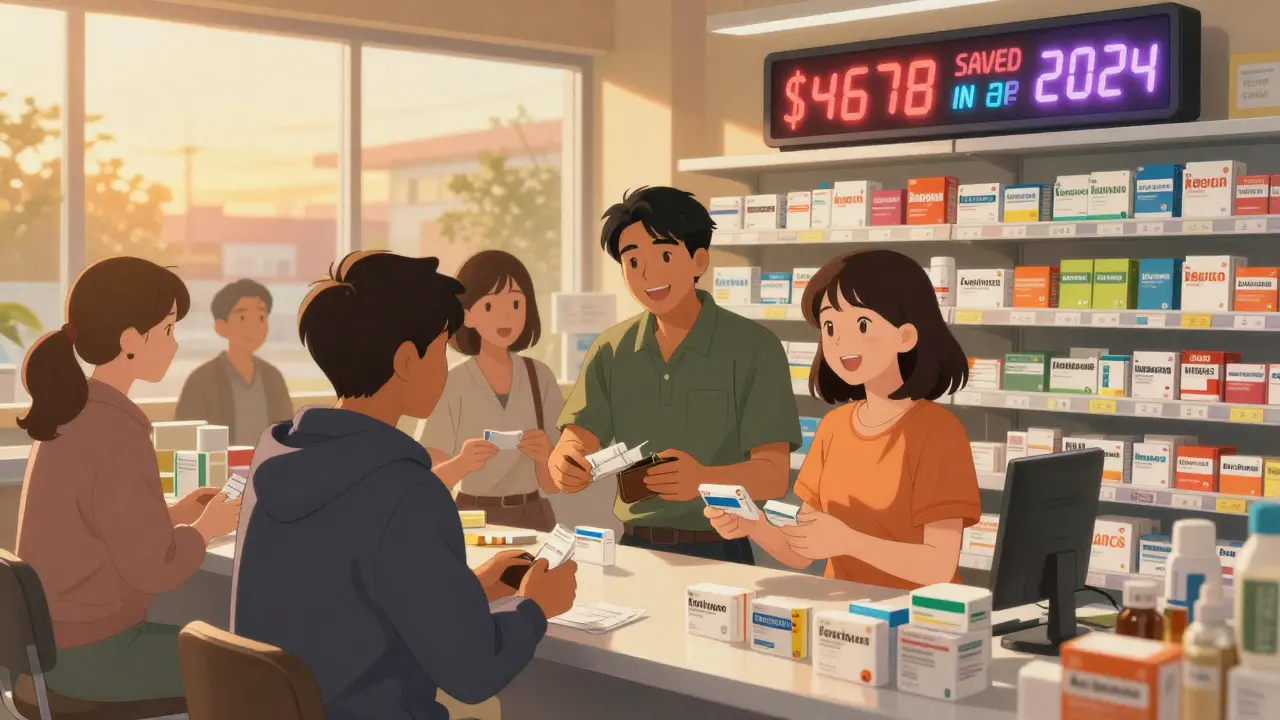
When you pick up a prescription, you might not think about how much you’re saving just because it’s a generic drug. But the numbers tell a powerful story. In 2024, generic and biosimilar medicines saved the U.S. healthcare system $467 billion. That’s not a typo. Half a trillion dollars in one year. And over the past decade, those same generics have saved more than $3.4 trillion. This isn’t theoretical. It’s real money-money that keeps people on their meds, lowers insurance premiums, and reduces out-of-pocket costs for millions.
How Much Do Generics Actually Cost?
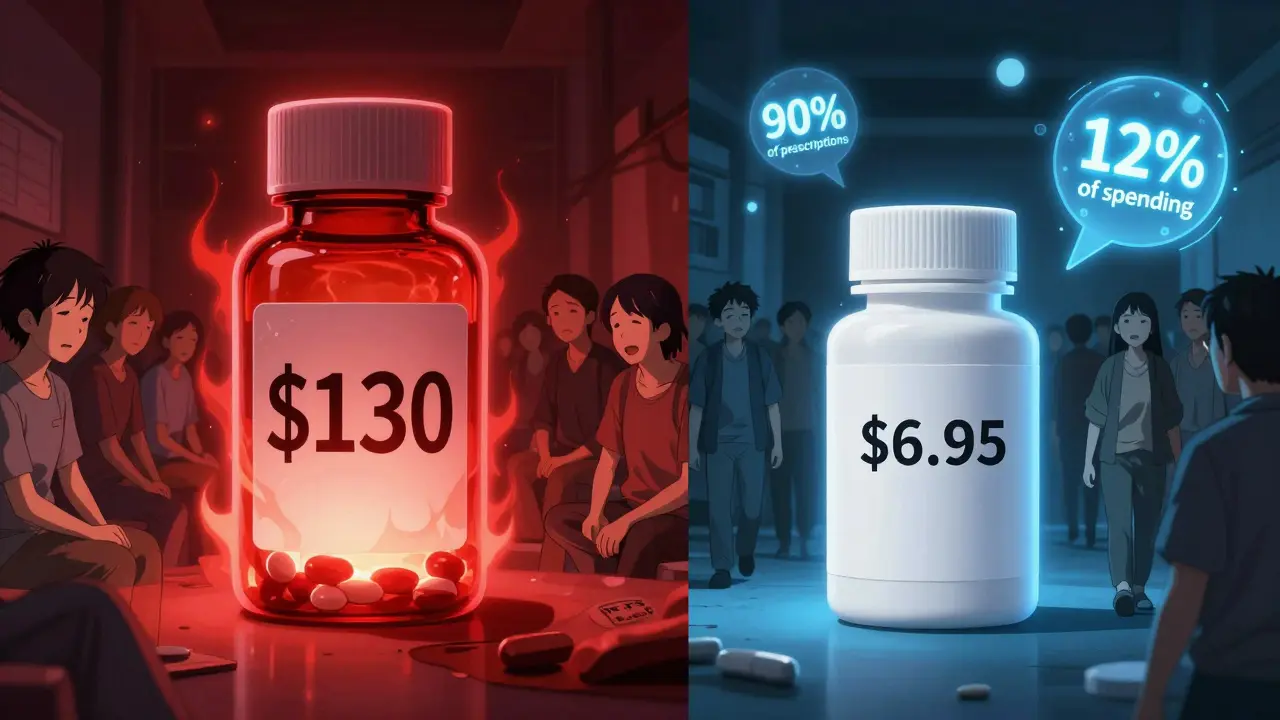
The difference in price between a generic and a brand-name drug isn’t small-it’s massive. In 2024, the average out-of-pocket cost for a generic prescription was $6.95. For a brand-name drug? $28.69. That’s almost five times more. And if you’re uninsured, the gap widens even further. Brand-name drugs cost an average of $130.18 per prescription for people without insurance, up about 50% since 2019. Meanwhile, generic prices actually dropped by 6% during the same period, falling by $2.45 per script.
Think about that. While brand-name companies kept raising prices, generic manufacturers kept lowering them-even as more people used them. In 2024, Americans filled 3.9 billion generic prescriptions. That’s 90% of all prescriptions written. Yet generics made up only 12% of total drug spending. Brand-name drugs? Just 10% of prescriptions, but 88% of the money spent.
Biosimilars Are Changing the Game
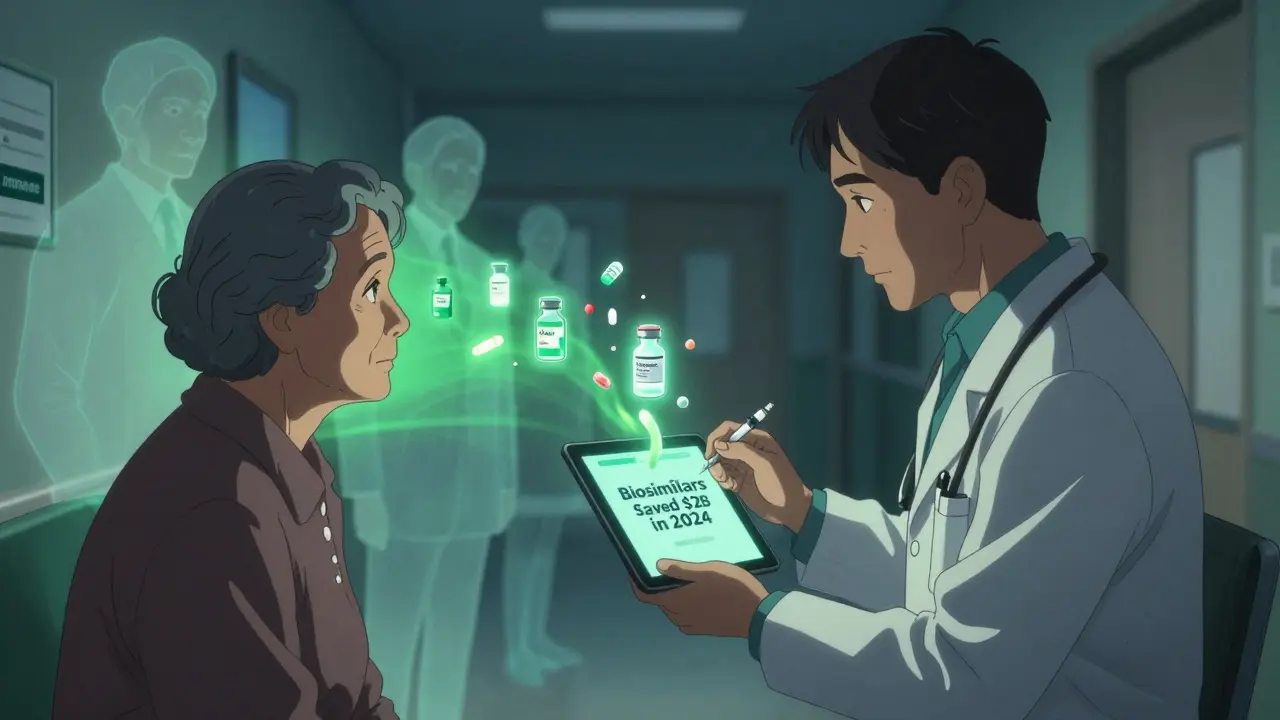
Biosimilars are the newer kids on the block, but they’re already making a huge impact. These are highly similar versions of complex biologic drugs-like those used for rheumatoid arthritis, cancer, or diabetes. In 2024 alone, biosimilars saved $20.2 billion, nearly double what they saved the year before. Since they first hit the market in 2015, they’ve saved the system $56.2 billion. And here’s the kicker: about 60% of those savings happened in just the last two years. Adoption is accelerating fast.
They’ve been used in nearly 3.3 billion days of patient therapy with no new safety issues reported. That’s not just cheap-it’s safe, proven, and growing. If you’re on a biologic right now, asking your doctor about a biosimilar could cut your costs by 30%, 50%, or even more.
Why Are Generics So Much Cheaper?
It’s not magic. It’s science and competition. When a brand-name drug’s patent expires, other companies can make the same medicine. They don’t have to repeat expensive clinical trials. They just need to prove it works the same way. That cuts development costs dramatically. Then, once multiple companies start making it, they compete on price. That’s why you’ll see the same pill-same active ingredient, same dose, same effect-sold under different names for $5, $10, or $15.
And it’s not just pills. Since 2015, the number of generic oral solids-pills and capsules-has gone up from 167 billion to 197 billion. More people are using them. But total spending on generics has actually dropped by $6.4 billion since 2019. That’s right. More volume, less cost. That’s the deflationary power of generics. No other sector in healthcare does that.
Brand-Name Drugs Are Getting More Expensive
While generics keep getting cheaper, brand-name drug makers are doing the opposite. In January 2025, major pharmaceutical companies raised prices on 250 drugs by a median of 4.5%. That’s nearly double the rate of general inflation. One drug, Vasostrict, had its list price slashed by 76% in just a few months-because a generic version finally hit the market. That’s the pattern: brand-name prices rise, generics arrive, prices crash.
Specialty drugs-often biologics or high-tech treatments-are the biggest cost drivers now. They’re expected to make up 60% of all drug spending by 2025, even though they’re prescribed far less often. That’s why biosimilars are so critical. Without them, those prices would keep climbing out of reach.
Who’s Saving the Most?
Medicare saved $142 billion in 2024 thanks to generics. That’s $2,643 per beneficiary. For many seniors, that means the difference between taking their blood pressure pill or skipping doses. Medicaid saw $17 million in net savings in June 2025 alone from generic drug deflation-meaning more drugs dropped in price than went up.
Even hospitals are feeling it. Outpatient medications at 340B hospitals cost $19.8 billion in 2024. With more generics and better pricing, that’s projected to drop to $10.2 billion by 2025. That’s $9.5 billion in annual savings. Over ten years? $144 billion.
The Hidden Threats to Generic Savings
Here’s the problem: the system that saves us money is under pressure. Generic manufacturers are barely making a profit. When prices drop so low, some companies stop making certain drugs. That’s when shortages happen. The Biosimilars Council warns that continued price deflation could lead to fewer manufacturers, fewer choices, and even drugs disappearing from shelves.
There are also shady practices holding back competition. Pay-for-delay deals-where brand-name companies pay generic makers to wait before launching their cheaper version-cost the system $12 billion a year. Ending those could save $45 billion over ten years. Another tactic, called "product hopping," is when a company slightly changes a drug just before the patent expires to block generics. Stopping that could save $1.1 billion over a decade.
Patent thickets-filing dozens of minor patents to delay competition-are another barrier. The Congressional Budget Office estimates cracking down on those would save $1.8 billion over ten years.
What You Can Do
Ask for the generic. Always. Even if your doctor doesn’t suggest it, you can request it. Pharmacists are required to substitute generics unless the prescription says "dispense as written." You don’t need to be a medical expert to save hundreds-or thousands-of dollars a year.
If you’re on a brand-name drug and it’s expensive, ask your doctor if a biosimilar is an option. Many insurers now require you to try the biosimilar first. If they don’t, ask why.
Use pharmacy discount programs. GoodRx, Blink Health, and even Walmart’s $4 list can drop your generic cost to $0 in some cases. These aren’t just for the uninsured-they work for anyone.
The Bigger Picture
Generics and biosimilars aren’t just a cost-cutting trick. They’re the backbone of affordable healthcare. They let people with chronic conditions stay on their meds. They keep Medicare solvent. They help employers control health plan costs. And they make sure no one has to choose between food and their insulin.
But that system is fragile. It only works if manufacturers can stay in business. If prices drop too far, companies leave. If patents are abused, competition stalls. If policymakers ignore the problem, we’ll see more shortages and higher costs down the road.
The data is clear: generics work. They save money. They save lives. And they’re the reason you’re not paying $200 for a month’s supply of metformin. But that’s only true if we protect them.
Are generic drugs as effective as brand-name drugs?
Yes. By law, generic drugs must contain the same active ingredient, strength, dosage form, and route of administration as the brand-name version. They must also meet the same FDA standards for quality, purity, and performance. The only differences are in inactive ingredients like fillers or dyes-which don’t affect how the drug works. Millions of people take generics every day with the same results as brand-name drugs.
Why are generic drugs cheaper if they’re the same?
Generic manufacturers don’t have to repeat expensive clinical trials to prove safety and effectiveness. They only need to show their version is bioequivalent to the brand-name drug. That cuts development costs dramatically. Plus, once multiple companies start making the same drug, they compete on price. That’s why generics get cheaper over time-even as more people use them.
Can I trust biosimilars for serious conditions like cancer or arthritis?
Absolutely. Biosimilars are rigorously tested and approved by the FDA. They’re not "similar enough"-they’re highly similar with no clinically meaningful differences in safety or effectiveness. Since 2015, biosimilars have been used in over 3.3 billion days of patient therapy with no unique safety concerns reported. Many patients switch from brand-name biologics to biosimilars without any change in how they feel.
Why do some pharmacies charge more for generics than others?
Prices vary because pharmacies negotiate different rates with wholesalers and PBMs (pharmacy benefit managers). Some chains like Walmart, Costco, and Target offer generics as low as $4 for a 30-day supply. Others charge more because they don’t participate in discount programs. Always compare prices using apps like GoodRx or SingleCare-sometimes the same generic costs $2 at one pharmacy and $15 at another.
Do insurance plans cover generics better than brand-name drugs?
Yes. Most insurance plans have lower copays for generics. Some even require you to try a generic first before covering the brand-name version. This is called "step therapy." It’s not a restriction-it’s a cost-saving tool that benefits you. If your plan denies coverage for a generic, ask why. It might be a billing error.
What happens if a generic drug runs out of stock?
Shortages happen when manufacturers stop producing a drug because the price is too low to make a profit. If your generic runs out, your pharmacist may switch you to another manufacturer’s version or, if needed, the brand-name drug. Always ask your pharmacist if there’s an alternative. You can also check the FDA’s Drug Shortages page for updates. In the long term, addressing price pressures on manufacturers is the only way to prevent this.
Winni Victor
December 25, 2025 AT 04:40Okay but have you seen the price of metformin at my pharmacy? $12 for 30 pills. Meanwhile my neighbor gets it for $3 at Walmart. This whole system is rigged. They want us to think generics are saving us but they just moved the scam to a different aisle. I swear, if I had to pay $12 a month for my diabetes meds, I’d start selling my kidneys on eBay.
Bailey Adkison
December 25, 2025 AT 08:03Generic drugs are bioequivalent by FDA standards but that doesn’t mean identical. Inactive ingredients vary. Some people have reactions to fillers. You’re not saving money if you end up in the ER because your generic had a dye that caused hives. The data looks good on paper but real bodies don’t always conform to statistics.
Katherine Blumhardt
December 27, 2025 AT 07:44My grandma switched to a biosimilar for her RA and now she’s crying every night because her joints hurt more 😔 I told her it was placebo but she swears the new one doesn’t work like the old one. Pharma companies are lying. They say they’re the same but they’re not. I’m scared for my mom’s cancer meds next.
Gary Hartung
December 27, 2025 AT 09:10Let’s be real-this whole ‘generic savings’ narrative is a distraction. The real issue is that Big Pharma is allowed to monopolize pricing for 20 years, then suddenly, when generics enter, they’re forced to sell at pennies. Who profits? Not patients. Not manufacturers. Just the middlemen-the PBMs. And don’t get me started on how they manipulate formularies…
It’s a shell game. You think you’re saving $467 billion? That’s just the money that got redirected into the pockets of CVS, Express Scripts, and UnitedHealth’s shadow subsidiaries. The patient still pays more than they should.
And biosimilars? They’re not cheaper because they’re better-they’re cheaper because they’re barely regulated. The FDA lets them skip Phase III trials if they’re ‘similar enough.’ Similar enough to kill someone? Maybe.
Ben Harris
December 27, 2025 AT 16:07Generics are fine for aspirin but when you’re on a biologic for lupus you don’t want to gamble with a $5 version that might not work. I’ve seen people switch and end up in the hospital. The savings are real but the human cost? Nobody talks about that. You can’t put a price on quality of life
Justin James
December 29, 2025 AT 05:05Have you ever stopped to think that the entire generic drug industry is a government-engineered illusion designed to make you feel better about being exploited? The patents expire, sure-but what if the original manufacturer secretly owns the generic company? Or what if the FDA is pressured by lobbyists to approve generics that barely meet standards? And don’t forget the Chinese suppliers-the ones who supply 80% of the active pharmaceutical ingredients-are underfunded, underregulated, and sometimes use industrial-grade chemicals that aren’t tested for human consumption. That $6.95 generic? It might’ve been made in a factory where workers are paid 37 cents an hour and the water supply is contaminated with mercury. You’re not saving money-you’re outsourcing your health to a global supply chain that doesn’t care if you live or die. The real savings? The ones corporations make when you die early and don’t collect Social Security.
And biosimilars? They’re just brand-name drugs with a new label. The clinical trials are shorter. The long-term effects? Unknown. We’re running a massive, uncontrolled experiment on 330 million Americans and calling it ‘affordable healthcare.’
And now they want us to trust Walmart’s $4 generics? That’s the same Walmart that sold tainted pet food and recalled cribs with lead paint. But sure-trust them with your insulin.
It’s not a savings story. It’s a slow-motion massacre.
Rick Kimberly
December 30, 2025 AT 20:35The data presented is compelling and aligns with peer-reviewed studies from the Congressional Budget Office and the Kaiser Family Foundation. The economic efficiency of generic substitution is well-documented, particularly in chronic disease management. However, one must also consider the unintended consequence of price compression on manufacturing viability. As noted, the thin margins have led to consolidation and supply chain fragility. A balanced policy framework-perhaps including a tiered pricing model for essential generics-could preserve both affordability and reliability. The ethical imperative is clear: access must not be sacrificed for cost.
Terry Free
December 31, 2025 AT 04:38Oh wow $467 billion saved? That’s cute. So why are my insulin co-pays still $300? Oh right-because the ‘savings’ go to the insurance companies and pharmacy benefit managers, not to me. You call that saving? I call it a magic trick where the money disappears into a black hole called ‘administrative overhead.’
And biosimilars? Yeah sure, they’re ‘safe.’ Just like how ‘low-fat’ food is healthy. Tell that to the guy who got a blood clot because his biosimilar had a different stabilizer.
They’re not saving us. They’re saving the system from having to fix the real problem: drug pricing.
Lindsay Hensel
January 1, 2026 AT 02:03Thank you for sharing this with such clarity. Many people don’t realize how much these medications impact daily survival-not just comfort. For seniors on fixed incomes, a $20 difference isn’t a savings metric-it’s whether they eat or take their pills. This is human, not economic. And we must protect it.
Sophie Stallkind
January 2, 2026 AT 06:10While the aggregate savings figures are impressive, the micro-level variability in access and pricing remains a significant concern. The disparity between pharmacy chains, coupled with inconsistent formulary coverage, undermines the equity of the system. Policy interventions should prioritize standardization of pricing benchmarks and transparency in PBM negotiations to ensure that savings reach patients uniformly.
Michael Dillon
January 3, 2026 AT 13:05Here’s the real twist: the reason generics are so cheap is because the FDA lets them skip the expensive trials-but what if the brand-name company still owns the patent on the manufacturing process? Or what if the generic maker is just a shell company owned by the same parent corporation? That’s not competition-that’s collusion with extra steps. And don’t get me started on how the same CEOs who run Pfizer also sit on the boards of generic manufacturers. This isn’t free market. It’s a rigged game with better PR.