When you pick up a prescription, you might see two options: the brand name drug you’ve heard of, or a cheaper generic version. Many people wonder - is the generic really the same? Can it be safe if it costs so much less? The answer isn’t just yes - it’s backed by some of the strictest science and regulation in medicine.
Same active ingredient, same effect
Generic drugs don’t just look similar to brand-name drugs. They have to be identical in one critical way: the active ingredient. That’s the part of the pill that actually treats your condition - whether it’s lowering blood pressure, fighting infection, or regulating thyroid function. The FDA requires that every generic contains the exact same active pharmaceutical ingredient (API), in the same strength, and delivered the same way - whether it’s a pill, injection, or inhaler.This isn’t a suggestion. It’s a legal requirement under 21 CFR 314.94(a). If a brand-name drug has 10 milligrams of lisinopril, the generic must have exactly 10 milligrams of lisinopril. No more. No less. No substitute. The FDA checks this during manufacturing inspections and again when reviewing applications for approval.
How do they prove it works the same way?
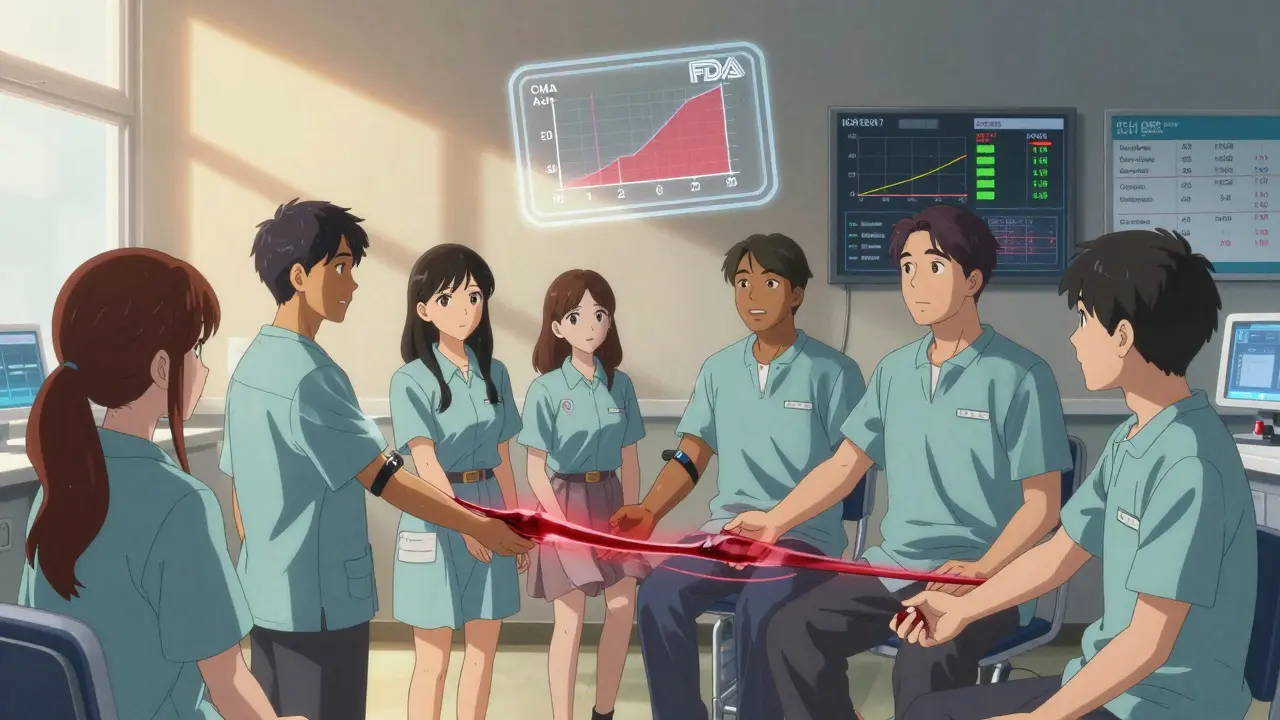
Knowing the ingredient is the same doesn’t mean the body will absorb it the same way. That’s where bioequivalence comes in. This is the core of the FDA’s safety standard for generics.Before a generic can be sold, it must pass a bioequivalence study. These studies involve healthy volunteers who take both the brand-name drug and the generic, then have their blood drawn over time. Scientists measure two things: how fast the drug gets into the bloodstream (Cmax) and how much of it gets absorbed overall (AUC). The FDA says the generic’s results must fall within 80% to 125% of the brand-name drug’s results - a range that accounts for normal biological variation.
For drugs with a narrow therapeutic index - like warfarin, levothyroxine, or lithium - the bar is even higher. The acceptable range tightens to 90% to 111%. That’s because even small differences in blood levels can cause serious side effects or make the drug ineffective. The FDA has specific guidance for these drugs, and manufacturers must show they can consistently hit that narrow target.
Manufacturing standards are just as strict
A lot of people think generics are made in cheaper, lower-quality factories. That’s not true. All drug manufacturers - whether making brand-name or generic drugs - must follow Current Good Manufacturing Practices (cGMP). These rules cover everything from how equipment is cleaned to how raw materials are stored.The FDA inspects every facility that makes generic drugs, including many overseas. In 2022, the agency increased inspections of foreign sites by 22% through its Risk-Based Facility Assessment program. Factories can’t just say they follow the rules - they have to prove it with records, calibration logs, and audit trails. One misstep - like a dirty mixing tank or uncalibrated scale - can delay approval for months.
Impurities are another big focus. The FDA uses international guidelines (ICH Q3B and ICH M7) to set limits on harmful byproducts. For example, any potential carcinogen in a drug must not exceed 1.5 micrograms per day - a level so low it’s considered safe even with lifelong use. Manufacturers must test for these impurities and document every step.
Dissolution and stability: it’s not just about what’s inside
A pill might have the right ingredient and the right amount - but if it doesn’t dissolve properly in your stomach, you won’t get the benefit. That’s why the FDA requires generic drugs to dissolve at the same rate as the brand-name version. This is tested using standardized methods that simulate conditions in the human digestive system.Stability testing is equally important. Generics must prove they’ll remain safe and effective for their entire shelf life - usually 12 to 24 months. That means storing samples under different temperatures and humidity levels, then testing them regularly to make sure nothing breaks down. If a generic tablet crumbles or changes color after six months, it gets rejected.
Labeling must match - almost exactly
The information on the drug label - warnings, dosing instructions, side effects - must be the same as the brand-name drug. The FDA calls this “same labeling.” The only allowed differences are things like the manufacturer’s name, packaging size, or color of the pill. Even the inactive ingredients (fillers, dyes, flavors) can be different - but only if they don’t affect how the drug works.Here’s where things get tricky. Some people report feeling different on a generic version - especially with levothyroxine. That’s often because they switched from one generic brand to another, and the inactive ingredients changed. The FDA allows this, but doctors sometimes recommend sticking with the same generic brand to avoid these small variations.
Complex drugs are harder to copy
Not all drugs are created equal. Simple pills are easy to replicate. But complex products - like inhalers, eye drops, or injectable biologics - are much harder. A generic inhaler doesn’t just need the same chemical. It must deliver the same size of particles to the same part of the lung. A generic cream must spread and absorb like the original.The FDA reports a 25% higher rejection rate for these complex generics. In 2022, 40% of ANDA submissions for complex products were initially refused because the manufacturer couldn’t prove equivalence. That’s why the FDA launched the Complex Generic Drug Products Initiative in 2018, investing $50 million to develop better testing methods. Some of this includes using AI to predict how a drug will behave in the body - a pilot program with MIT is already underway.
Real-world evidence backs up safety
There’s a lot of fear around generics. But the data tells a different story. A 2022 study in JAMA Internal Medicine looked at 38,000 Medicare patients taking statins. It found no difference in heart attacks, strokes, or deaths between those on brand-name and generic versions. Another analysis of 12,500 patient reviews on Drugs.com showed 87% reported no difference in effectiveness for cardiovascular drugs.Even in tough cases like epilepsy, a 2021 survey of 500 neurologists found 68% trusted generic antiseizure medications. That’s not because they’re blind to risks - it’s because the science supports it.
There are exceptions. A small group of patients report issues with generic levothyroxine. But the FDA’s own data shows that when patients are switched between different generic brands - not between brand and generic - they’re more likely to notice changes. That’s a formulation issue, not a safety failure.

Why does this matter?
Generic drugs make healthcare affordable. In 2022, they made up 90% of all prescriptions filled in the U.S. - but only cost 23% of total drug spending. That’s billions saved every year. Without generics, millions of people couldn’t afford their meds.The FDA’s system isn’t perfect. Some complex drugs still lack reliable generic versions. But the framework is designed to protect patients while allowing competition. The agency reviews about 1,000 generic applications every year. Most get approved. Those that don’t are rejected for clear, technical reasons - not because they’re “cheap” or “inferior.”
The future is moving toward even better standards. In 2022, the FDA proposed a rule allowing generic manufacturers to update safety labels without waiting for the brand-name company. That’s a big step - it means warnings about new side effects can reach patients faster.
What you should know as a patient
If your doctor prescribes a brand-name drug, you can ask for the generic - unless there’s a medical reason not to. Most insurance plans require it. If you notice a change in how you feel after switching, talk to your pharmacist or doctor. Don’t assume it’s the drug. It could be a change in inactive ingredients, or even stress, diet, or sleep.Stick with the same generic brand if you’re sensitive to small changes. Keep your prescriptions at the same pharmacy. Don’t switch back and forth between different generic manufacturers unless your doctor says it’s safe.
The bottom line? Generics aren’t a compromise. They’re the result of one of the most carefully regulated systems in medicine. The FDA doesn’t cut corners. It just skips the parts that don’t need to be repeated - because the science already proves the active ingredient works.
Are generic drugs as safe as brand-name drugs?
Yes. The FDA requires generic drugs to meet the same strict standards for safety, strength, purity, and quality as brand-name drugs. They must contain the same active ingredient, work the same way in the body, and be manufactured under the same rules. Thousands of studies and real-world data confirm they’re equally safe and effective.
Why do generic pills look different?
Generic pills can differ in color, shape, size, or flavor because those are inactive ingredients. The law allows this to avoid trademark issues with the brand-name version. But the active ingredient - the part that treats your condition - must be identical. These differences don’t affect how the drug works.
Can I trust generics made outside the U.S.?
Yes. The FDA inspects all facilities that make drugs sold in the U.S., no matter where they’re located. In 2022, over half of generic drugs were made overseas - mostly in India and China - but the FDA’s inspection rate for foreign sites increased by 22% since 2020. All must meet U.S. manufacturing standards.
Why do some people say generics don’t work for them?
Sometimes, people switch between different generic brands and notice a change. That’s usually because the inactive ingredients changed - like the filler or coating - which can slightly affect how fast the drug is absorbed. This is rare and usually minor. For drugs like levothyroxine, even small changes can matter. If you feel different, talk to your doctor - you may need to stick with one brand.
Are all generics approved the same way?
No. Simple pills use the standard Abbreviated New Drug Application (ANDA) process. But complex products - like inhalers, injectables, or topical creams - require additional testing to prove they work the same way. The FDA has special guidelines for these, and approval takes longer. About 30% of pending generic applications involve complex drugs.
How long does it take for a generic to get approved?
It typically takes 18 to 36 months from development to approval. The FDA’s average review time for a first-time application is about 10 months. Complex generics take longer - sometimes over two years - because they need extra testing. The Generic Drug User Fee Amendments (GDUFA) have helped cut approval times by 35% since 2012.
What’s next for generic drugs?
The FDA is working on new tools to keep up with increasingly complex medications. One project uses artificial intelligence to predict harmful impurities before they even appear in production. Another focuses on modeling how drugs behave in the body - replacing some animal and human tests with computer simulations.The goal is simple: keep generics affordable, safe, and available - without slowing down innovation or cutting corners. As more drugs go off-patent, the system will be tested more than ever. But the foundation - rigorous science, strict oversight, and transparency - hasn’t changed since 1984. And it’s working.
Rachel Liew
January 31, 2026 AT 22:38i switched my blood pressure med to generic last year and honestly? i didn’t notice a difference. my doctor said it’s the same stuff, and i trust that. also saved me like $40 a month. win-win.
Nicki Aries
February 2, 2026 AT 17:33Let me tell you-this is one of the most important things the FDA ever got right. I mean, seriously. People act like generics are some kind of shady discount aisle product, but no. It’s science. It’s regulation. It’s the same exact molecule doing the same exact job. And yet, we still have people scared to take them? Unbelievable.
Ed Di Cristofaro
February 2, 2026 AT 21:59generic drugs are fine if you’re fine with getting ripped off by the system. but hey, if you wanna live like a peasant, go ahead. i take the brand name because i don’t trust these overseas factories. someone’s gotta pay for quality.
vivian papadatu
February 3, 2026 AT 20:55As someone who’s been on levothyroxine for 12 years, I can say this: consistency matters. I stick with one generic brand because switching between them-even though they’re all “FDA-approved”-can make me feel off. It’s not the active ingredient. It’s the fillers. The FDA lets that slide, but if you’re sensitive, your pharmacist can help you track which one you’re on. 🙏
Melissa Melville
February 5, 2026 AT 18:03soooo… you’re telling me the blue pill that costs $4 is literally the same as the pink one that costs $40? and i’m supposed to believe that? 😂
Deep Rank
February 6, 2026 AT 09:16you know what’s really scary? that 40% of generic applications get rejected for complex drugs. that means almost half the time, companies can’t even copy them right. and yet, we’re pushing people to switch? what if your asthma inhaler doesn’t deliver the right dose? what if your insulin doesn’t absorb? this isn’t just about money, it’s about people’s lives. and the FDA? they’re just checking paperwork. they don’t even test every batch. they trust the company. that’s not safety, that’s gambling.
Bryan Coleman
February 6, 2026 AT 12:14my uncle’s on warfarin and he switched to generic-no issues. his INR stayed stable. the FDA’s 90-111% range? that’s not arbitrary. it’s based on decades of data. people panic because they don’t understand the science. not the drug’s fault.
Sami Sahil
February 7, 2026 AT 22:33bro, generics are the real MVP. without them, my mom couldn’t afford her diabetes meds. she’s been on the same generic for 5 years and still running 10k marathons. stop being scared of cheap. be grateful for smart.
Bob Cohen
February 9, 2026 AT 08:20so let me get this straight: the FDA approves a generic because it’s 80-125% as effective as the brand? that’s a 45% swing. that’s like saying a 70mph car is ‘equivalent’ to a 100mph car. and we call this science? lol.
Ishmael brown
February 10, 2026 AT 18:53they say generics are safe… but have you seen the factory videos? 🤫 the ones from India? they’re not even allowed in the U.S. for tourism, but we let them make our pills? 🤔
Jaden Green
February 11, 2026 AT 15:03It’s fascinating how the FDA’s entire framework is predicated on a flawed assumption-that bioequivalence in healthy volunteers translates to therapeutic equivalence in patients with comorbidities, polypharmacy, or metabolic variations. The data is statistically significant, yes, but clinically? Anecdotal evidence abounds. I’ve seen patients decompensate after switching. The FDA doesn’t track adverse events in real time. They rely on voluntary reporting. That’s not oversight. That’s negligence dressed up as regulation.
Lu Gao
February 12, 2026 AT 20:25the fact that people still think generics are ‘inferior’ is just… sad. 🤦♀️ we’re talking about molecules here. not magic. if the active ingredient is identical and the absorption profile is within FDA limits, it’s the same drug. period. also, the color difference? that’s just trademark law. not science. 🧪
Angel Fitzpatrick
February 13, 2026 AT 13:38the FDA? they’re in bed with Big Pharma. brand-name companies own the patents, then license the generics to their own subsidiaries. the whole system’s rigged. they let you think you’re saving money, but the same corporations are still getting paid-just through the back door. and the AI modeling? that’s just a distraction. they’re not replacing animal tests-they’re automating the cover-up.
Nidhi Rajpara
February 14, 2026 AT 11:32While I appreciate the thoroughness of the regulatory framework, I must express my concern regarding the potential for cross-contamination in overseas manufacturing facilities. The documentation may be compliant, but the human factor remains unpredictable. In my professional experience, even minor lapses in hygiene can lead to catastrophic outcomes. I urge greater transparency in facility audits and mandatory third-party verification.