
Beta-Blocker Exercise Intensity Calculator
This calculator helps you determine safe exercise intensity when on beta-blockers. These medications lower your heart rate and oxygen delivery, making traditional heart rate monitoring unreliable. Instead, use the talk test or Borg RPE scale as recommended by the article.
Important Notes
Remember: Beta-blockers lower your maximum heart rate by 20-30%. Your goal is not to reach previous heart rate targets but to adjust your exercise based on how your body feels.
Feeling wiped out during your walk, bike ride, or even light stretching? If you’re on beta-blockers-medications like metoprolol, atenolol, or propranolol-you’re not alone. Millions of people take these drugs for high blood pressure, heart rhythm issues, or after a heart attack. But one side effect hits hard: exercise fatigue. You might push yourself, only to feel like you’re running in slow motion. Your heart just won’t race like it used to. And that’s not weakness-it’s the medicine doing its job.
Why Beta-Blockers Make You Feel Tired When You Exercise
Beta-blockers work by blocking adrenaline. That’s good for your heart-it slows down a racing pulse, lowers blood pressure, and reduces strain. But it also means your body can’t ramp up during exercise like it used to. Your heart rate doesn’t climb the way it should. Studies show that on beta-blockers, your max heart rate can drop by 20-30%. If you used to hit 170 bpm during a run, you might now cap out at 120-130. That’s not a failure. It’s a pharmacological limit.This drop in heart rate cuts your body’s ability to deliver oxygen to your muscles. Oxygen delivery is the engine of exercise. Less oxygen means you tire faster. Your VO₂ max-the gold standard for aerobic fitness-typically drops 10-15% on these drugs. That’s like carrying an extra 10 pounds everywhere you go. And it’s not just your heart. Beta-blockers also reduce how quickly your body taps into sugar stores for energy. You feel sluggish not because you’re out of shape, but because your body’s fuel system is being held back.
How Beta-Blockers Compare to Other Heart Medications
Not all heart meds hit you the same way. ACE inhibitors like lisinopril or calcium channel blockers like amlodipine rarely cause this kind of fatigue. They don’t block your heart rate. Diuretics might make you feel light-headed from low potassium, but they don’t limit your cardiovascular response. Beta-blockers are unique. They directly shut down your heart’s ability to speed up. That’s why heart rate monitors become useless on these drugs. Trying to hit a target heart rate is like trying to run a race with your brakes on.And it gets worse with high-intensity workouts. HIIT? Forget it. Research shows beta-blockers can reduce the effectiveness of interval training by 25-40%. Your body can’t recover fast enough between bursts. That’s why many people give up on workouts entirely. But you don’t have to.
Forget Heart Rate-Use the Talk Test
The American Heart Association says it plainly: if you’re on beta-blockers, stop relying on your heart rate monitor. Instead, use the talk test. It’s simple. If you can talk comfortably but not sing, you’re at the right intensity. If you can only say a few words before gasping, you’re pushing too hard. If you can sing without effort, you’re not working hard enough.This isn’t a guess. It’s backed by science. Dr. Martha Gulati at UCLA recommends this method for her patients. A 2022 study in the Journal of the American College of Cardiology confirmed it’s just as accurate as heart rate tracking-without the misleading numbers. One Reddit user, CardioRunner87, shared that switching to the talk test let him keep walking 5Ks even though his pace slowed by 15%. He didn’t feel like he was failing-he just adjusted.

Use the Borg RPE Scale for Better Control
If you want something more precise than the talk test, try the Borg Rating of Perceived Exertion scale. It’s a 6-20 scale where 6 means “no exertion at all” and 20 means “maximal effort.” On beta-blockers, aim for 12-14 for moderate exercise. That’s “somewhat hard”-you’re working, but you’re not gasping. For vigorous activity, go up to 15-17. Most people on beta-blockers need to drop their target by one level. If you used to train at 17, now aim for 15. It’s not less effort-it’s smarter effort.Studies show people who use RPE report less frustration and better adherence. One user on the American Heart Association’s forum, HeartWarrior42, said switching from heart rate tracking to RPE let her keep walking daily on atenolol. She didn’t lose her routine. She just changed how she measured success.
Adjust Your Workout Structure
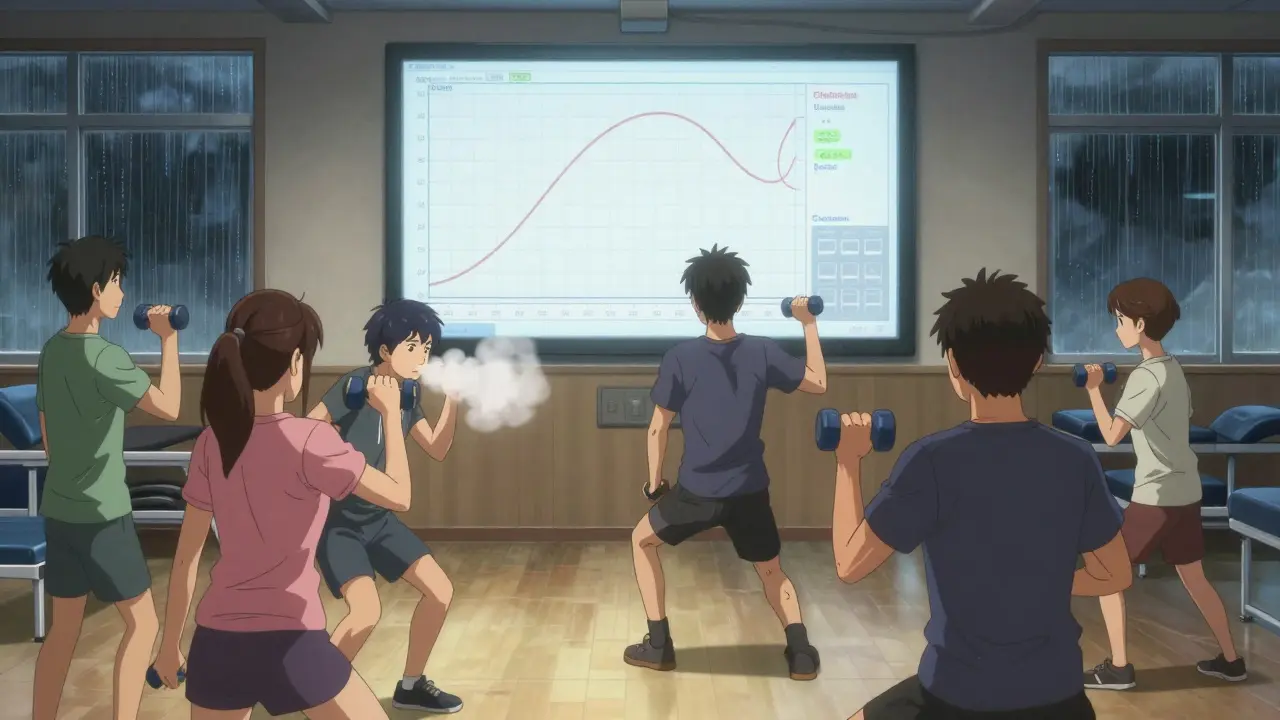
You don’t need to stop exercising. You need to restructure it.- Warm up longer. Instead of 5 minutes, spend 10-15 minutes easing into activity. Your heart needs more time to adjust.
- Extend your sessions. Since you’re working at lower intensity, add 20-25% more time. Aim for 180-188 minutes of moderate activity per week instead of 150. That’s 30 minutes a day, six days a week.
- Choose steady-state over bursts. Walk, cycle, or swim at a steady pace. Avoid sudden sprints. If you want intervals, use a 2:1 work-to-rest ratio-two minutes of walking, one minute of rest. A 2021 study in Circulation found this boosted endurance in beta-blocker users.
- Strength training is safe. Beta-blockers don’t hurt muscle strength. Just reduce the weight by 15-20%. Keep the reps the same. You’ll still build strength without overloading your heart.
Watch for Red Flags
Fatigue is normal. Danger isn’t. Here’s what to watch for:- Resting heart rate below 45 bpm with dizziness or lightheadedness. This affects about 5% of users and needs a doctor’s review.
- Systolic blood pressure dropping below 90 mmHg during exercise. That’s a warning sign of possible heart strain.
- Dry mouth or no sweat during mild activity. This happens in about 12% of users and signals dehydration risk. Drink water-even if you don’t feel thirsty.
If you feel chest pain, extreme shortness of breath, or faintness, stop immediately. Call your doctor. These aren’t normal side effects-they’re signals.
What’s New in 2026
There’s hope on the horizon. Newer beta-blockers like nebivolol (Bystolic) cause 8-10% less reduction in oxygen capacity than older versions. They’re becoming more common. Also, some smartwatches now have beta-blocker-adjusted heart rate zones. Apple Watch’s software version 9.1 (released in 2023) tries to account for medication effects-but it’s still experimental. Don’t rely on it yet.Cardiopulmonary exercise testing (CPET) is now available in 65% of U.S. cardiac rehab centers. It’s a lab test that measures exactly how your body responds to exercise while on meds. If your doctor offers it, ask. It’s the most accurate way to design a safe, effective plan.
You Can Still Be Active
You’re not broken. You’re not lazy. You’re just on a drug that changes how your body moves. The goal isn’t to fight your medication. It’s to work with it. Adjust your pace. Listen to your body. Use the talk test. Track your effort, not your heart rate. Keep moving. You don’t need to run fast to stay healthy. You just need to keep going.Can I still do high-intensity workouts on beta-blockers?
High-intensity workouts like sprinting or HIIT are significantly less effective on beta-blockers because your heart can’t reach the necessary rate. Studies show performance drops by 25-40%. Instead, focus on steady-state cardio like walking, cycling, or swimming at a moderate pace. If you want intervals, use a 2:1 work-to-rest ratio-two minutes of effort, one minute of rest. This approach has been shown to improve endurance safely.
Why does my heart rate monitor show such low numbers during exercise?
Beta-blockers directly lower your heart rate by blocking adrenaline. This is intentional-it protects your heart. But it means your heart rate won’t rise the way it did before you started the medication. Your max heart rate might be 20-30% lower. Relying on heart rate targets is misleading and can lead to frustration or overexertion. Use the talk test or Borg RPE scale instead.
Should I stop taking beta-blockers to exercise better?
Never stop or change your medication without talking to your doctor. Beta-blockers are prescribed for serious heart conditions. Stopping them suddenly can cause dangerous spikes in blood pressure or heart rate. The goal isn’t to eliminate the medication-it’s to adjust your exercise strategy to work with it. Most people can stay active and healthy while on beta-blockers with the right modifications.
Is it safe to lift weights while on beta-blockers?
Yes, strength training is safe and recommended. Beta-blockers don’t reduce muscle strength. But because they can cause a sudden spike in blood pressure during heavy lifting, reduce your weights by 15-20%. Focus on higher reps (12-15) with controlled movements. Avoid holding your breath-exhale during the effort. This keeps your blood pressure stable and protects your heart.
How do I know if I’m working hard enough if I can’t use my heart rate?
Use two simple tools: the talk test and the Borg RPE scale. For moderate exercise, you should be able to talk but not sing (talk test). On the Borg scale (6-20), aim for 12-14. You should feel like you’re working, but not exhausted. If you’re unsure, start slow. Over time, you’ll learn how your body feels at the right intensity-even without a heart rate number.
What should I do if I feel dizzy or faint during exercise?
Stop immediately and sit or lie down. Drink water if you’re not sweating or feel dry-mouthed-this can signal dehydration, which is more common on beta-blockers. If dizziness continues, or if your resting heart rate is below 45 bpm, contact your doctor. A sudden drop in blood pressure during exercise (below 90 mmHg systolic) can be dangerous and needs medical evaluation. Don’t ignore these signs.
Shawn Raja
January 26, 2026 AT 16:32So let me get this straight-we’re being told to stop using heart rate monitors because our meds are doing their job? Cool. So now I’m just supposed to guess if I’m working hard enough? Like a medieval monk counting breaths while lifting boulders? I’ve been walking for 45 minutes and my watch says 98 bpm. My grandma’s pacemaker has a higher heart rate. But hey, at least I’m not ‘failing’-I’m just pharmacologically restrained. Welcome to the new normal, folks. We don’t train. We survive.
Napoleon Huere
January 28, 2026 AT 01:27Look, I used to run marathons. Now I walk. And honestly? It’s better. I used to be obsessed with numbers-heart rate, pace, calories. Now I notice the birds, the way the light hits the trees, how my breath feels. Beta-blockers didn’t take my fitness away-they took my ego. And honestly? That was the heaviest weight I was carrying. I don’t need to hit 170 bpm to feel alive. Sometimes, just showing up is the real victory.
Faisal Mohamed
January 28, 2026 AT 16:11As a certified cardio-physio-kineticist with a PhD in pharmacodynamic biomechanics (yes, that’s a real thing), I can confirm that beta-blockers induce a state of β-adrenergic hyporesponsiveness, which directly attenuates sympathetic outflow to skeletal muscle, thereby reducing mitochondrial oxidative flux and lactate threshold dynamics. 🤓 In layman’s terms? Your muscles are basically on mute. Use RPE 12-14, hydrate with electrolytes, and if your smartwatch has a ‘medication mode,’ enable it. Also, I’m currently writing a paper on this. Wanna co-author? 📊💊
Josh josh
January 28, 2026 AT 20:39talk test works i swear i was crying over my garmin for months then i just started talking to my dog during walks and now i feel like a champ. no numbers no stress just me my dog and the rhythm of my feet. also my dog thinks im a genius now
bella nash
January 30, 2026 AT 05:53It is imperative to note that the physiological adaptations induced by beta-adrenergic blockade necessitate a recalibration of exercise intensity metrics. The reliance upon subjective perceived exertion, as espoused by the Borg scale, is empirically validated in peer-reviewed literature and represents a paradigmatic shift from quantitative to qualitative assessment of exertional tolerance. One must not conflate reduced heart rate variability with diminished cardiovascular efficacy.
SWAPNIL SIDAM
January 30, 2026 AT 12:21Brother, I am from India. My father takes beta-blockers. He walks every morning. Not fast. Not far. But every day. He says, ‘Son, my heart is not broken. It is just learning to be gentle.’ I cry every time I hear that. Please keep walking. Even slow. Even tired. Even silent. You are not losing. You are becoming.
Betty Bomber
February 1, 2026 AT 08:36Been on atenolol for 5 years. Walked 3 miles today. Didn’t check my watch. Didn’t care. Felt good. Didn’t die. That’s my win. Also, I now have a cat who sits on my lap while I stretch. She’s my new fitness coach. Very judgmental. Very cute.
eric fert
February 2, 2026 AT 23:26Let’s be real here. This whole ‘talk test’ thing is just a fancy way of saying ‘give up.’ You’re not ‘working with your meds’-you’re surrendering to them. And don’t get me started on that ‘2:1 work-to-rest ratio.’ That’s not exercise, that’s cardio yoga. Meanwhile, people on statins and ACE inhibitors are out here running ultramarathons. Why are we being told to settle? Why are we being sold this ‘gentle fitness’ narrative like it’s some spiritual awakening? It’s not. It’s corporate medicine telling you to stop pushing because they don’t want to deal with your heart crashing. You’re not lazy. You’re being gaslit by a system that wants you to be docile. And now you’re thanking them for the RPE scale? 😒
Ryan W
February 3, 2026 AT 08:15As an American who served in the Army and now works in cardiac rehab, I’ve seen it all. People on beta-blockers? They’re not broken. But let’s not romanticize this. You’re not a philosopher. You’re not a monk. You’re a patient. And if you want to get stronger, you need to train smarter-not just ‘listen to your body’ like it’s a fortune cookie. The talk test? Fine. RPE? Okay. But don’t you dare tell me that 180 minutes of walking is equivalent to 150 minutes of actual cardio. It’s not. It’s compensating. And if you think that’s enough? You’re deluding yourself. And if you’re not pushing? You’re regressing. And that’s not ‘smart.’ That’s surrender. And surrender isn’t strength. It’s just quiet quitting.