When you hear the words breast cancer, what comes to mind? Fear? Uncertainty? Maybe you’ve heard conflicting advice about when to start screening, whether 3D mammograms are worth it, or what happens after a diagnosis. The truth is, we now have clearer, more evidence-based answers than ever before - and they matter more than ever for women starting at age 40.
Why Screening Starts at 40 - And Why It Matters
For decades, the idea was that breast cancer screening should begin at 50. But things have changed. In 2024, the American College of Obstetricians and Gynecologists (ACOG) updated its guidelines to say: all women at average risk should start screening mammography at age 40. This wasn’t a random shift. It was based on hard data. Studies show that breast cancer is rising in women under 50. In fact, about 1 in 8 women will develop breast cancer in their lifetime, and nearly 40% of those cases occur before age 50. A 2016 meta-analysis of nine large clinical trials found that regular mammography reduces the risk of dying from breast cancer by about 12%. That’s not a small number. It means for every 1,000 women screened regularly from age 40 to 74, roughly 3 to 4 deaths are prevented. The U.S. Preventive Services Task Force (USPSTF) still recommends biennial (every two years) screening for women aged 40 to 74, but they now give a Grade B recommendation for women 40 to 49 - meaning the benefits clearly outweigh the risks. The American Cancer Society and the American Society of Breast Surgeons go even further, recommending annual screening starting at 40. Why the difference? Because newer data shows that catching cancer early - before it spreads - dramatically improves survival. And the earlier you catch it, the less aggressive the treatment needs to be.Digital Mammography vs. 3D Mammography: What’s the Difference?
Not all mammograms are the same. There are two main types: 2D digital mammography and 3D mammography, also called digital breast tomosynthesis (DBT). Traditional 2D mammograms take two flat images of each breast - one from the top, one from the side. It’s been the gold standard for decades. But here’s the problem: breast tissue is layered. Overlapping tissue can hide small tumors or create false shadows that look like cancer. That’s why some women get called back for more tests - even when nothing’s wrong. 3D mammography changes that. Instead of two flat images, it takes dozens of low-dose X-rays from different angles and builds a 3D model of the breast. Think of it like flipping through a photo album page by page instead of trying to see through a stack of photos. This makes it easier to spot tumors, especially in women with dense breasts. Studies show 3D mammography reduces false positives by up to 15% and increases cancer detection rates by 20% to 40% in women with dense tissue. The American Society of Breast Surgeons now recommends 3D mammography as the preferred screening tool. Medicare covers both 2D and 3D mammograms annually. If you’re over 40 and have dense breasts, ask your doctor: Is 3D an option for me?Who Needs Extra Screening - And What Does It Look Like?
Not all women have the same risk. If you have a family history of breast cancer, carry a BRCA1 or BRCA2 gene mutation, had radiation to the chest before age 30, or have a lifetime risk of 20% or higher, your screening plan changes. For these higher-risk women, guidelines agree: annual mammography plus breast MRI. MRI is far more sensitive than mammography alone. It doesn’t use radiation - it uses magnets and radio waves - and it’s excellent at finding cancers that mammograms miss. The American Cancer Society recommends starting this combo at age 30 for women with known genetic mutations or strong family histories. What about dense breasts without other risk factors? This is tricky. The USPSTF says there’s not enough evidence to recommend routine ultrasound or MRI for dense breasts alone. But the American Cancer Society says it’s reasonable to discuss supplemental screening with your doctor. Why? Because dense breasts can hide cancer - and they also increase cancer risk slightly. If your mammogram says you have heterogeneously or extremely dense breasts, ask: Should I add an MRI or ultrasound?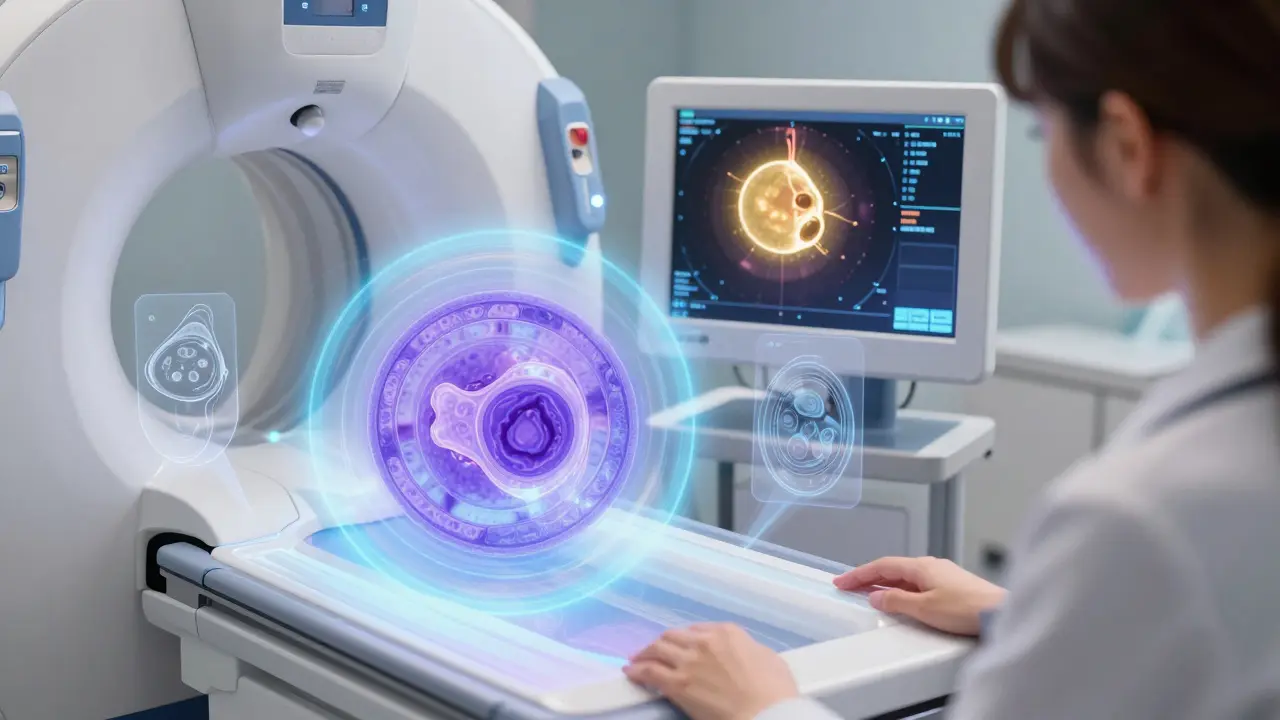
When Does Screening Stop?
There’s no magic age when screening suddenly becomes pointless. The key is life expectancy - not calendar years. Most guidelines agree: if you’re in good health and expect to live another 10 years or more, screening should continue. That means many women in their late 70s or even 80s still benefit. A 2024 study in JAMA Oncology found that women aged 75 to 84 who continued annual screening had a 35% lower risk of dying from advanced breast cancer than those who stopped. The goal isn’t to screen forever. It’s to screen as long as treatment would still make a difference.What Happens After a Diagnosis? The Treatment Algorithm
Screening finds the cancer. Treatment decides what to do next. And here’s where things get personal - because no two breast cancers are the same. After a biopsy confirms cancer, doctors look at three key things:- Stage - How big is the tumor? Has it spread to lymph nodes or other organs? (This is the TNM system: Tumor size, Node involvement, Metastasis.)
- Biology - Is the cancer hormone-receptor positive (ER/PR)? Is it HER2-positive? Is it triple-negative?
- Genetics - Tests like Oncotype DX or MammaPrint look at the tumor’s gene activity to predict how likely it is to come back.
- Surgery - Either breast-conserving surgery (lumpectomy) or mastectomy. Most women with early-stage cancer can keep their breast.
- Radiation - Usually given after lumpectomy to kill any leftover cells. Sometimes after mastectomy if the tumor was large or spread to lymph nodes.
- Systemic Therapy - This includes hormone therapy (for ER/PR-positive cancers), targeted drugs (like Herceptin for HER2-positive), or chemotherapy (for aggressive or high-risk tumors).
What’s Missing From the Conversation?
Most people don’t realize that screening isn’t just about machines. It’s about access. In Australia, public screening programs (like BreastScreen Australia) offer free mammograms every two years for women 50 to 74. But what about women 40 to 49? They’re not covered. Many women in this group pay out of pocket - or skip it entirely. The same gap exists in parts of the U.S. and other countries. Also, genetic testing isn’t offered to everyone. If you have a family history of breast or ovarian cancer, you might qualify for BRCA testing. But only 1 in 3 women who meet the criteria get tested. That’s a missed opportunity. And let’s not forget: mammograms aren’t perfect. They can miss cancers. They can cause anxiety. They can lead to overdiagnosis - finding slow-growing tumors that might never have caused harm. But the benefit of catching aggressive cancers early still outweighs these risks for most women.What Should You Do Now?
If you’re 40 or older:- Ask your doctor: Am I at average risk?
- Ask: Should I get a 3D mammogram?
- Ask: Do I need genetic counseling? - especially if you have a family history.
- Ask: What happens if something shows up? - know the next steps before you need them.
Do I need a mammogram if I have no family history of breast cancer?
Yes. About 85% of breast cancers occur in women with no family history. Your risk comes from age, hormones, lifestyle, and random genetic changes - not just inheritance. Screening isn’t just for those with a family tree full of cancer. It’s for everyone.
Is 3D mammography better than 2D?
For most women, especially those with dense breasts, yes. 3D mammography (DBT) finds more cancers and reduces false alarms. It’s now the preferred method by leading breast societies. If your clinic offers it, ask for it. If they don’t, ask why - and whether they plan to upgrade.
Can I skip mammograms if I do self-exams?
No. Breast self-exams are not a replacement for mammography. Studies show they don’t reduce cancer deaths. While knowing your body is helpful, most early cancers are too small to feel. Mammograms detect tumors years before they can be felt.
What if I’m over 75? Should I still get screened?
It depends on your health. If you’re active, independent, and expect to live another 10+ years, yes. If you have serious chronic illness or limited life expectancy, screening may not help. Talk to your doctor about your personal situation - don’t assume age alone decides this.
Do I need a referral to get a mammogram?
In Australia, no - BreastScreen Australia allows women 50-74 to book directly. In the U.S., many insurance plans cover screening without a referral. Check with your provider. If you’re under 50 or have risk factors, you may need a doctor’s note, but it’s often a simple form.
Can mammograms cause cancer from radiation?
The radiation dose from a mammogram is extremely low - less than a standard chest X-ray and far less than what you get from natural background radiation in a year. The risk of harm from this radiation is negligible compared to the benefit of catching cancer early. Not getting screened carries a much higher risk.
What if I’m transgender or non-binary? Do these guidelines apply to me?
Yes. Guidelines are based on breast tissue, not gender identity. Anyone with breast tissue - including trans women and non-binary people who have undergone hormone therapy or breast development - should follow the same screening recommendations as cisgender women. If you’ve had a mastectomy, screening isn’t needed unless tissue remains. Always discuss your history with your provider.
Shameer Ahammad
March 18, 2026 AT 21:41Let me be unequivocally clear: starting mammograms at 40 is not merely prudent-it is a non-negotiable public health imperative. The data is irrefutable. A 12% reduction in mortality? That’s not a statistic-that’s lives saved. And yet, I’ve seen women delay screening due to misinformation, fear, or worse-complacency. The notion that 'I feel fine' is a dangerous fallacy. Breast cancer does not announce itself with fanfare; it creeps. 3D mammography is not optional for dense tissue-it is the standard. If your clinic still uses 2D, demand an upgrade. Or go elsewhere. Your life is not a budgetary constraint.
Alexander Pitt
March 20, 2026 AT 02:16The guidelines have evolved because the science has improved. What’s critical is that screening isn’t one-size-fits-all. A woman with dense breasts and no family history still needs 3D mammography. A woman with a BRCA mutation needs MRI. And yes-screening should continue as long as life expectancy exceeds 10 years. The key is personalized risk assessment, not age alone. If your doctor isn’t discussing your individual risk profile, find one who will.
Manish Singh
March 21, 2026 AT 10:06As someone from India, I’ve seen how access to screening is a luxury. In rural areas, women don’t even know what a mammogram is. Urban centers have the tech, but cost and stigma keep people away. I had my aunt skip screening for two years because she thought it meant 'cancer was coming.' She didn’t know it was about prevention. We need more community education-not just clinical guidelines. And yes, 3D is worth it. My cousin’s early detection was thanks to it. No drama. Just facts. And a little compassion.
Robin Hall
March 22, 2026 AT 09:42Who funds these 'guidelines'? The radiology industry? The mammogram machine manufacturers? The 12% mortality reduction figure ignores overdiagnosis-where harmless lesions are treated aggressively, causing unnecessary mastectomies and chemotherapy. The USPSTF’s original recommendation was based on minimizing harm. Now, it’s pushed by profit-driven lobbies. Radiation, even minimal, accumulates. And what about the psychological toll of false positives? Are we trading anxiety for a marginal gain? I’m not anti-screening-I’m pro-ethics.
jared baker
March 23, 2026 AT 01:22Simple truth: if you’re 40+, get a mammogram. 3D if you can. No need to overthink it. Breast cancer doesn’t care if you’re scared, busy, or broke. It just grows. Screening saves lives. That’s it.
Michelle Jackson
March 23, 2026 AT 04:18Okay but like… why is everyone acting like mammograms are magic? I had one last year and they called me back for 'additional views.' Turned out it was just dense tissue. But I cried for three days. And then I had to pay $400 out of pocket even though I had insurance. So now I’m like… maybe I’ll just wait till I feel a lump. Because honestly? The system is broken. And don’t even get me started on how they never explain what 'heterogeneously dense' even means. #OverIt
Suchi G.
March 24, 2026 AT 19:28I remember the day my mother got her first mammogram at 42-she was terrified. Not of cancer, but of being alone in that room, of the cold machine, of the technician’s silence, of the waiting. I was 16. I didn’t know then that 40% of breast cancers happen before 50. I only knew she didn’t cry until she got the all-clear. Now I’m 38, and I just had my first 3D mammogram. I cried too. Not from fear. From gratitude. For the technology. For the doctors. For the women who fought to make this routine. I wish she could have known how far we’ve come. I wish every woman could feel this safe. I wish the system didn’t make it so hard to get there.
becca roberts
March 25, 2026 AT 05:56Oh wow, so now we’re all supposed to be grateful for the fact that our bodies are treated like suspicious packages at the airport? Let me guess-next they’ll be offering free mammograms at Costco next to the rotisserie chickens. 'Buy two, get one free!' I mean, sure, the science says 'do it,' but why does it feel like we’re being sold a service instead of being given care? And don’t even get me started on the trans guidelines. At least someone’s thinking about inclusion. Even if it’s just to tick a box. 🙃
Andrew Muchmore
March 26, 2026 AT 17:40Screening saves lives. 3D is better. Ask your doctor. Don’t wait. That’s all you need to know.