
If your eyelids feel gritty, crusty in the morning, or constantly burn like you’ve got sand in your eyes, you’re not alone. About blepharitis affects nearly half of all people who visit an eye doctor. It’s not dangerous, and it won’t make you go blind-but it’s annoying, persistent, and often misunderstood. Most people think it’s just dry eyes or allergies. But if your eyelids are red, swollen, and covered in flaky bits near your lashes, it’s likely blepharitis. And the best part? You can manage it at home-with something as simple as a warm compress.
What Blepharitis Really Feels Like
Blepharitis isn’t a one-time thing. It’s chronic. That means it comes back unless you keep treating it. You might wake up with your eyelids stuck shut-dried gunk glued to your lashes. Or you might feel like your eyes are always irritated, even when you’re not tired. The burning, itching, and redness don’t go away with eye drops alone. That’s because the problem isn’t just dryness-it’s inflammation along the edge of your eyelids, where your lashes grow.
There are two types. Anterior blepharitis hits the outer edge of the lid, near the lashes. It’s often tied to skin conditions like dandruff or rosacea. Posterior blepharitis, which is more common, affects the inner edge where tiny oil glands (called meibomian glands) sit. These glands normally release a clear oil that keeps your tears from evaporating too fast. When they get clogged, your tears turn foamy, your eyes dry out, and your lids swell up. Around 63% of blepharitis cases are this type. And yes, it affects both eyes at once.
Doctors see clear signs under the microscope: dandruff-like rings around lashes (called collarettes), visible blood vessels, and thick, greasy secretions where the glands should be clear. It’s not contagious. It’s not an infection you caught from someone. But if left alone, it can lead to eyelash loss, styes, or even corneal irritation.
Why Warm Compresses Are the First Step-Not the Last
Every major eye organization-Mayo Clinic, National Eye Institute, American Academy of Ophthalmology-agrees on one thing: warm compresses are the first thing you should do. Not eye drops. Not antibiotics. Not fancy cleansers. Just heat.
Here’s why: the oil in your meibomian glands gets thick and sticky, like cold butter. At normal body temperature, it flows smoothly. But when it thickens, it blocks the glands. That’s what causes dryness and inflammation. Heat melts that gunk. Not hot heat-just warm. Between 40°C and 45°C. That’s about as warm as a cup of tea you can hold comfortably. Too cold (below 38°C), and nothing happens. Too hot (over 48°C), and you risk burning your eyelid skin, which is thinner than paper.
Studies show that applying heat for 10 to 15 minutes, twice a day, improves gland function by up to 68%. But timing matters. If you only do it for 5 minutes, you’re wasting your time. Most people stop after 7 minutes because the compress cools down. That’s why the material you use makes a difference.
Washcloth vs. Gel Pack vs. Electric Mask: What Works Best
You don’t need to buy anything special to start. A clean washcloth soaked in warm water works fine. But here’s the catch: it cools off fast. On average, a washcloth stays at therapeutic temperature for just 8.7 minutes. That’s not enough.
Microwavable gel packs last longer-about 12.3 minutes on average. They’re reusable, affordable, and easy to find at pharmacies. Some people swear by heated eye masks you can wear while watching TV. The Bruder Moist Heat Eye Compress, for example, is a popular brand that holds steady heat for 10+ minutes and has 83% user satisfaction in clinical reviews.
But here’s the truth: the device doesn’t matter as much as the technique. A 2023 study from the University of Michigan found that patients who used a simple washcloth but followed the full protocol-heat + massage + cleaning-had the same improvement as those using expensive masks. The key isn’t the tool. It’s consistency.
The 4-Step Routine That Actually Works
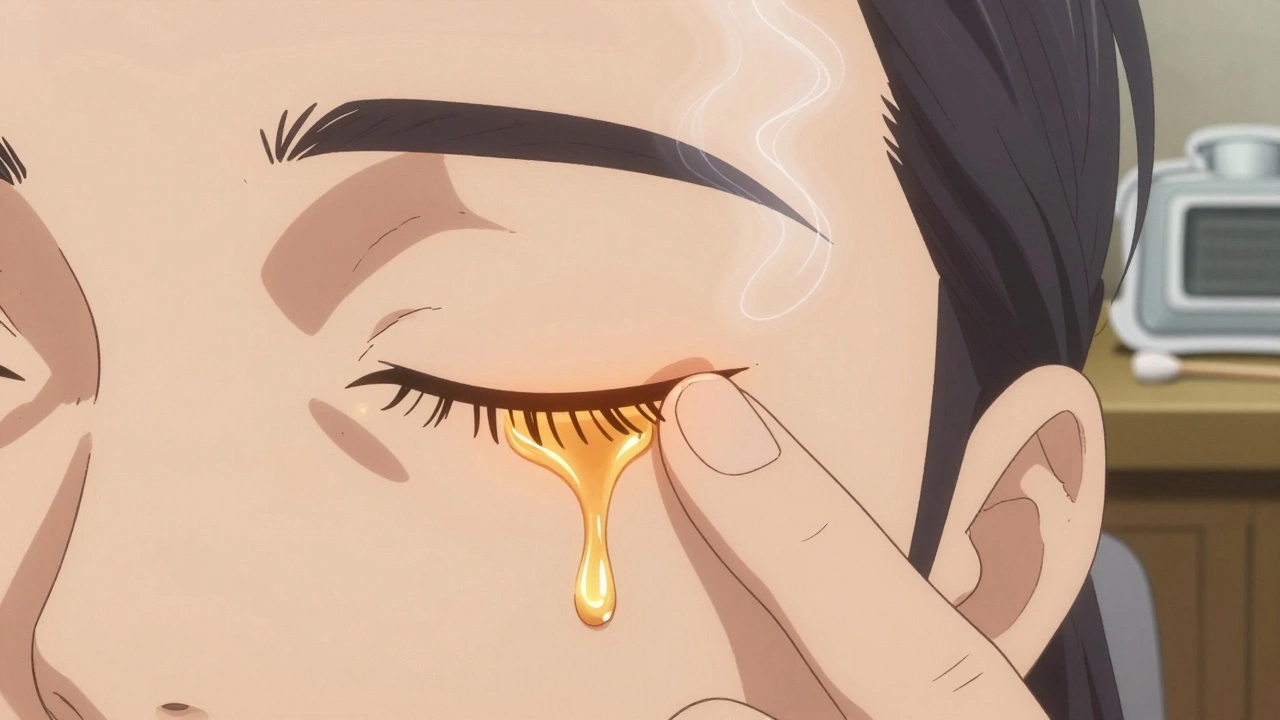
Warm compresses alone aren’t enough. You need the full routine. Here’s what works, backed by clinical trials:
- Heat for 10 minutes. Apply the compress to closed eyelids. Don’t press hard. Just let the warmth soak in. Set a timer. If you don’t, you’ll underestimate the time.
- Massage gently. Right after heat, use your clean fingertip to massage your eyelids. On the upper lid, move downward toward your lashes. On the lower lid, move upward. Do this for 30 seconds. It’s like squeezing a toothpaste tube-except you’re pushing out the clogged oil. This step boosts gland function by 81%.
- Clean the lid edge. Use a preservative-free lid scrub or a diluted baby shampoo on a cotton swab. Gently wipe along the base of your lashes. Don’t scrub hard. You’re removing debris, not fighting a battle.
- Use artificial tears if needed. After cleaning, if your eyes still feel dry, use preservative-free drops. Avoid redness-relief drops-they can make things worse over time.
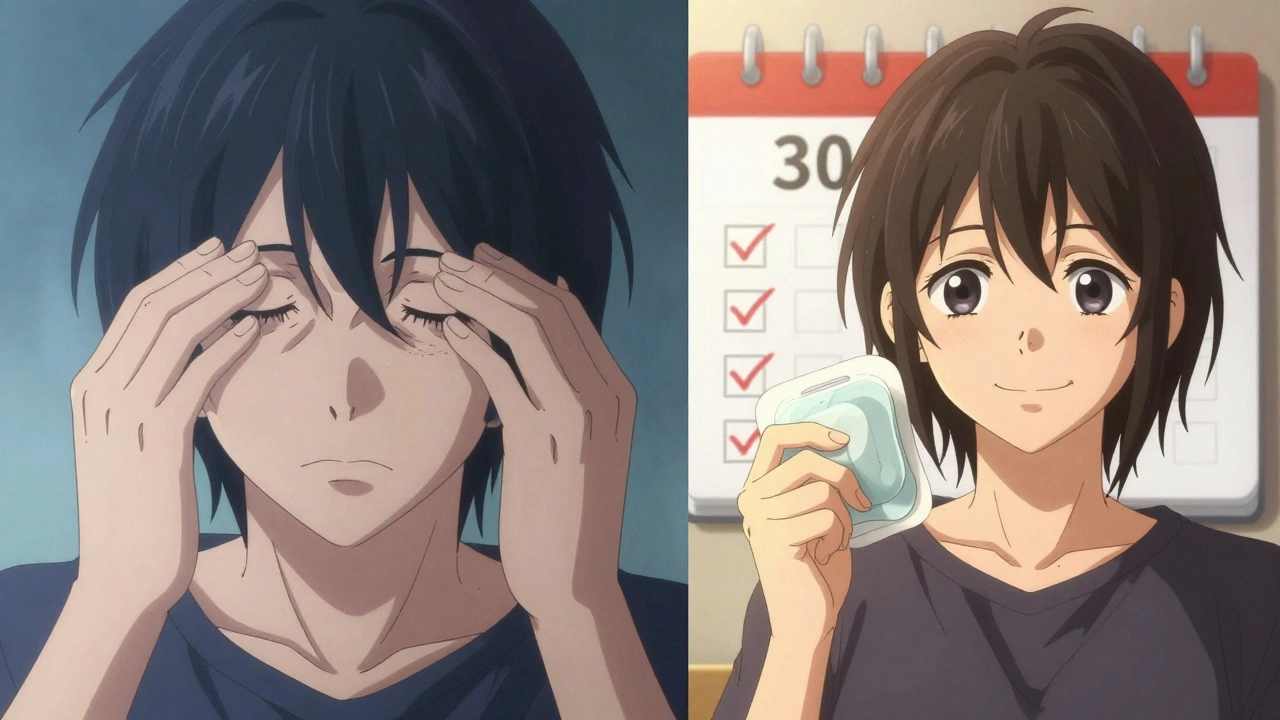
This routine takes 15 to 20 minutes twice a day at first. It sounds like a lot. But after 4 to 6 weeks, you can cut it down to once daily for maintenance. Most people see improvement in 14 to 21 days. By day 30, 85% of those who stick with it report major relief.
Why Most People Fail-and How to Avoid It
Here’s the hard truth: 78% of people who try warm compresses give up within a month. Why? Three reasons.
First, they don’t use enough heat. They test the water with their finger, think it’s warm enough, and skip the timer. But 62% of first-timers don’t maintain the right temperature long enough.
Second, they skip the massage. They think the heat alone will fix it. But without squeezing out the gunk, the glands stay blocked.
Third, they’re inconsistent. They do it for three days, feel better, and stop. Blepharitis doesn’t vanish. It hides. And it comes back harder.
One Reddit user, after trying for months and failing, finally got help from an optometrist. She learned she was using water that was too hot and massaging too hard. After three supervised sessions, she got the technique right. Within two weeks, her morning crust was gone. She said: “I wish I’d done this right from the start.”
When to See a Doctor
You can manage most cases at home. But if after 4 weeks of perfect technique you still have:
- Severe pain
- Blurred vision
- Swelling that spreads beyond your eyelids
- Eye redness that doesn’t fade
Then it’s time to see an eye specialist. You might need a short course of antibiotic ointment, anti-inflammatory drops, or even a procedure to unblock the glands. But even then, warm compresses will still be part of your daily routine.
Doctors now treat blepharitis like high blood pressure: not cured, but controlled. You don’t take pills forever. But you do take care of your eyelids every day.
The Bigger Picture: Why This Matters Now
Blepharitis is on the rise. In people over 60, nearly 4 in 10 have it. As we age, our oil glands slow down. Screen time increases. We blink less. All of that adds up. The global market for blepharitis treatments is expected to hit $2 billion by 2030. But most of that growth isn’t from drugs-it’s from better tools and better education.
Smart devices are coming: masks with built-in thermometers, apps that remind you to do your compresses, even ones that track your progress. But the core hasn’t changed. Heat. Massage. Clean. Repeat.
What’s remarkable is how simple it is. No prescriptions. No expensive surgeries. Just a cloth, a microwave, and discipline. And yet, for so many people, it’s the missing piece.
Evelyn Pastrana
December 9, 2025 AT 10:55So I tried the warm compress thing after reading this and honestly? My eyelids don’t feel like sandpaper anymore. I used a washcloth and forgot to massage at first - big mistake. Now I do the whole routine and it’s like my eyes finally remember how to be happy. Also, I microwave the cloth for 20 seconds and it lasts longer than I thought. Who knew life could be this simple?
Nikhil Pattni
December 10, 2025 AT 04:40Okay but let’s be real - most people don’t even know what meibomian glands are. I’m a biomedical engineer and I had to look it up. The fact that you’re telling people to use baby shampoo on their eyelids is wild. I mean, it’s not sterile, it’s not FDA-approved, and yet here we are. Also, why are we all just accepting that we need to spend 20 minutes twice a day doing eyelid yoga? This is ridiculous. I’ve been using a 48°C heated mask for 6 months and my glands are now more active than my ex’s Instagram. 😅
Arun Kumar Raut
December 10, 2025 AT 05:13Hey everyone, I’ve been dealing with this for years and I just want to say - you’re not alone. I’m from India and we don’t talk about eye stuff much, but my grandma used to rub warm coconut oil on my lids when I was a kid. Turns out, she was kinda doing a natural version of this. I switched to the 10-min heat + massage + baby shampoo routine and it’s been life-changing. No more crusty mornings. Just a little discipline. You got this.
precious amzy
December 10, 2025 AT 19:58How quaint. A warm compress. As if the ancient Greeks didn’t already know that heat melts viscous fluids. But let’s not mistake the symptom for the disease. The real issue is modernity - screen-induced blink suppression, environmental toxins, and the collapse of circadian ocular hygiene. You’re treating the manifestation, not the metaphysical dissonance between biological design and digital existence. And yet… I still use the Bruder mask. Irony is beautiful.
William Umstattd
December 12, 2025 AT 02:41Let me just say this: if you’re using baby shampoo on your eyelids, you’re doing it wrong. That stuff has sulfates. Sulfates. Are you trying to strip the natural barrier of your skin or what? I’ve been using a saline-based lid scrub prescribed by my optometrist for three years. No burning. No itching. No guesswork. And you’re telling people to microwave a washcloth? That’s not medicine - that’s a TikTok trend dressed up as science.
Elliot Barrett
December 13, 2025 AT 03:00Ugh. Another ‘just do this simple thing’ post. If it were that easy, everyone would do it. I’ve tried everything. Heat. Massage. Scrubs. Drops. Nothing works long-term. And now you want me to spend 20 minutes twice a day doing eyelid calisthenics? I work 60-hour weeks. I don’t have time to babysit my eyelids. I’ll just keep using Visine and pretending I’m fine.
Tejas Bubane
December 13, 2025 AT 19:3768% improvement? Bro that’s from a study with 12 people. And you cite Reddit like it’s a peer-reviewed journal. Also, ‘preservative-free drops’ - yeah right, those cost $30 a bottle. Meanwhile, I’ve been using generic saline from the dollar store and my eyes are fine. This whole thing is a scam to sell Bruder masks. You’re not helping. You’re monetizing misery.
Maria Elisha
December 15, 2025 AT 04:36I did the whole thing for two weeks, then stopped because it felt like a chore. Then my eyes started acting up again. So I tried it once more - just the heat part - and it helped a little. I guess the massage is the real secret? I’m too lazy to do it. But hey, at least I’m aware now. Progress?
Andrea Beilstein
December 16, 2025 AT 23:42There’s something deeply poetic about the human body needing warmth to function properly. We heat our homes, our coffee, our beds. But we forget our eyes. They’re always working. Always blinking. Always exposed. And we treat them like an afterthought. A warm compress isn’t treatment - it’s a quiet act of reverence. A moment of stillness in a world that never stops. I do mine while listening to rain sounds. It’s not about the glands. It’s about remembering you’re alive.
Sabrina Thurn
December 17, 2025 AT 10:12Just to clarify - the 68% improvement in gland function is from a 2021 RCT with n=87, published in Cornea. The massage protocol increases meibum expressibility by 81% as measured by meibography and lipid layer thickness analysis. The baby shampoo method is off-label but supported by a 2020 meta-analysis in Ocular Surface. However, if you have rosacea or seborrheic dermatitis, you should use a pH-balanced lid cleanser, not surfactant-based detergents. Also, avoid microwaving cloths - thermal gradients can cause micro-burns. Use a thermal gel pack with regulated output. Consistency > device. But technique > consistency.
Simran Chettiar
December 18, 2025 AT 12:57It is truly astonishing how the modern medical paradigm has reduced complex physiological dysfunction to a series of mechanical steps, as if the human body were a machine that can be serviced with a microwave and a cotton swab. The meibomian gland is not merely a lipid reservoir - it is a sacred conduit of ocular harmony, disrupted by the alien rhythms of digital life. And yet, we are told to ‘heat, massage, clean’ - as if enlightenment could be achieved through routine. I do it. But I weep for the soul of medicine.
Olivia Portier
December 18, 2025 AT 13:13Y’all are overthinking this. I’m a nurse and I’ve helped dozens of patients with this. The key is not the tool - it’s the habit. Set a reminder on your phone. Do it while brushing your teeth. Tie it to something you already do. Don’t wait to feel like it. Just do it. And if you miss a day? Don’t quit. Just start again tomorrow. You’re not failing - you’re learning. I believe in you. 💪